What is this thing called Coaching?

shutterstock_288163295 PB Coaching

When I am asked what I do, I answer differently depending on my mood, my energy in the moment. I might say that I help people get out of their own way, or to create a life/business/career by design as opposed to by default. I sometimes say that I support people in achieving more external achievement (Success) AND more internal fulfillment. And sometime I just say I’m a personal and professional coach. And usually people go either” OK, got it” without really getting it or “what kind of coaching?”. The truth is coaching is used for so many different things that it is confusing for a lot of people. I therefore wanted to talk a little bit about what is and is not and will do in different posts.

So, let’s start today with the basics:

What Coaching is Not:

It’s often clearer to explain what something is by defining what it is not. So here are 2 services with which coaching is often mistaken:

  • Consulting: a consultant is someone who comes with a certain expertise, with solutions to propose, who might even do the work for you and deliver the end result. A consultant might come with a strategy to grow your business, some recommendations to improve your relationships or your management. They will usually come with answers, tips, advice and tell you what to do. A lot of coaches are also blending coaching with consulting which is totally fine but which explains why it might be confusing to some people. 
  • Psychotherapy: Coaching might involve some deep personal introspection which we are not used to and which may make it a little scary to some but it is not a therapy. A simplified but rather clear way to separate therapy from coaching is the following:
    • Therapy is focused on the past and painful issues, aiming at coming to term with these.
    • Coaching is focused on the present and the future, the past might come into play but it is a fact, not a problem.

People can work with both a coach and a psychotherapist at the same time. I found that one the reason that hold people back from even just trying to work with a coach is the belief that if you see a coach, it means something is wrong with you and you have to fix it. People are then worried about what other might think about them. If you or some people you know are in that case, I am inviting you to shift the perspective to something that is inspiring and moving you toward the life you REALLY want to create.

What is Coaching?

The International Coach Federation defines it as follows:

“Coaching is a partnership with clients in a thought provoking and creative process that inspires them to maximize their personal and professional potential.”

There are different coaching models, different coaching styles and there is no ONE way to go with a coaching session (I’ll talk about this more in another post). But there are some mains common skills and core competencies that are taught in proper coaching trainings, like coaching presence (being really present and connected with the person), powerful questioning (asking questions that will move the person forward and stay stuck or help shift their perspective), active deep listening (what is said, how it is said, what is not said), direct communication (to create shifts, to challenge, to support), creating awareness (helping to see in our blind spots), designing actions (how to put into practice the insights to move forward). These skills and competencies might seem obvious and easy but believe me, mastering them is not.

In a world where we are used to give advice, look for the right way to do things, it can feel weird the first time you are being coached. But it also feels great. Because you feel heard (and sometimes that’s all you need), not judged (who can you talk to without fear of being judged or concerned by what the person is going to think), unconditionally supported. And it is powerful because it is about finding what YOU need, what is YOUR perspective and YOUR best way to move on (sometimes you don’t even need a solution, the problem might just disappear) and YOUR greatness and genius is trusted and enhanced in the process.

Sometimes, shifts happen during a session, with a big haha moment, when the light goes off suddenly, like the fish which now sees the water he is in and couldn’t see before since he had been completely immersed in it since he was born. Sometime, there is just a “hum” which indicates that something is happening. Sometime, a seed is planted that will grow later and have ripple effects. An insight might come in between sessions. Or at the end of the session, it might feel like chaos, which is great and just means the work is being done. Often, people will even change or create new results without realizing it until someone points it out to them. And all this add up, week after week, month after month, to create a new reality and a new experience of life.

To conclude, I like to say that coaching is:

  • Some skills and competencies to learn and nurture
  • An art, developed by each coach in a different and personal way
  • A science (science of the mind, neurosciences, behavioral sciences, etc.)

In the end, it’s not magical but it sometimes looks like magic. I know it as a coach and as a client (I have my own coach).

Take care,

Only 10%

Photo by HENCE THE BOOM on Unsplash

Photo by HENCE THE BOOM on Unsplash

This week, I want to illustrate that sometimes, although we might we feel like there is a world between us and what we want to achieve, the gap is not that big.

US tennis player Danielle Collins was the revelation of the women Australian Open Grand Slam tournament, reaching the semi-final for the first time in her career. In quarter final, she managed to beat Anastasia Pavlyuchenkova, 2-6, 7-5, 6-1 after losing the 1st set 6-2. In this 1st set, Pavlyuchenkova broke her 3 first serves and Collins was down 5-1. But she didn’t give up nor panic:

Honestly, I lost that set pretty quickly,” Collins said. “But what was going through my mind was that I think I had at least two break points that I didn’t convert. Even though the set was 6-2, it took an hour. I felt like it was very close, regardless of the score. I told myself, ‘Hey, if I can just give a little bit more, 10 percent or 15 percent, I have an opportunity.’ Yeah, I stayed positive through that and kind of weathered the storm.”

I really love the way she didn’t let the score of the 1st set (6-2) mean anything (it could sound like she was hugely dominated) but instead relied on her sensations and analysis.

Lots of us see things as all or nothing, black or white. When it’s not white, it means it’s black, when it’s not all, it’s nothing. No surprise that the gap often feels very big, close to 100% and therefore impossible or at least really difficult to bridge. But if we can see that the gap may be much smaller and ask ourselves what tiny change can I make, where can I give 10% more (energy, focus, calm, determination, precision, …whatever it is that we need), then it’s easier to make the necessary changes, we have more confidence in being able to do it and in the end we can make what feels impossible possible.

If you are racing (running, swimming, cycling) and are used to mentally or physically giving up at a certain point, can you go just 10% further instead of trying to hold the whole race right away?

If you are a golfer, can you manage your emotions 10% better instead of trying to manage them 100% and be even more frustrated if you don’t do it?

Lots of team sport games are very indecisive and focusing on giving 10% more rather than thinking you don’t seem to be able to and won’t find the solution can make the difference.

So, where can you give only 10% more to make a difference?

Take care,


How overthinking might get in your way

Photo by Cristina Pop on Unsplash

I am an over thinker. What I mean by that is I tend to analyze, to want to understand and optimize everything, to need everything to be clear before engaging.
There is nothing wrong with that. It comes from a survival mechanism (a way to operate in the world that we developed over the years since we were born) which enables me to:

  • Feel safe: if I can think of everything that needs to be done, everything that can go wrong, understand how things work, to be in control, then I know where I am going. Then I can’t fail, or at least I minimize the risk of failures. And I feel safe.
  • Optimize: since I was a kid, I always wanted to have it all. When I was asked do you want A or B, I would say both and I was said it’s impossible, I would find ways to demonstrate that it was possible, it was just a matter of motivation and optimization.
  • Seek perfection, which is great for a perfectionist.

There are some benefits to overthink:

  • I am usually good, sometime great, at what I do
  • I am pretty reliable to do what I have to do
  • I am professional
  • I am rarely taken aback
  • I am in control, stay safe and it feels good

Now here is the flip side:

  • The most obvious one is that it costs a lot of time trying to optimize and plan for everything. I remember, in my previous career as a project manager, spending hours to review and tweak my slides for the steering committees of boards of Directors. All this for details that no one would even notice. Now I’m not saying I should have gone unprepared, it was of course a good thing to anticipate what could go wrong and to clear my message but not that much.
  • It creates blind spots. When doing my first videos on Facebook, I was so much overthinking about how I should do it, what people would think and so concerned about bothering people (that’s one of my internal roadblocks) that I didn’t realize that I was actually posting on my Facebook Page, my wall. It’s like being scared to bother people with what you are doing in your own home which sounds ridiculous. But I didn’t see that, lost in my overthinking.
  • It holds me back from taking actions and doing things. Since I need everything to be clear before I move on so, I will prepare and prepare and prepare but this just postpones the time for me to take a leap. And it’s an easy way to avoid doing what’s uncomfortable.
  • It creates frustration when things don’t unfold as planned, and they most often don’t. If you spend so much time thinking and preparing something, the frustration is even bigger when it doesn’t happen the way you want
  • It kill possibilities: as soon as I start to think, fear will show up, and my brain will find all the reasons why doing that thing is impossible or irrelevant, or not worth it, and why I should stay comfortable where I am.
  • I miss opportunities: By the time I have gone through my process, analysis, optimization, decision making and I am ready, the opportunity is gone. Really.

What do I do with this?  

  • I notice when I tend to overthink and I ask myself “what do I want to do now?”, to be at choice rather than it being an automatism.
  • I practice raising my hand without knowing. This analogy comes from when my coach invited me to raise my hand, in a group coaching program I am in, even before I start to think about whether my question is good enough, whether I want to coach or be coached, etc… Very challenging. The few times I did it though, it was great. I didn’t have the opportunity to stress, I just dived in. This happened recently as I was on a call with Michael Neil, a very notorious coach, in a group program. I just raised my hand and was coached by him in front of a hundred of people, on video. It didn’t feel stressful or awesome, it just was. Only the next day did I start to overthink again (“oh, I must have looked stupid etc…”). So, I try to practice just doing without knowing all I would normally need to know, but I must admit it is still hard.
  • I have a post-it in front of me where it is written: Seeking Perfection is easier than Taking Action. A great reminder to check if what I am trying to do by thinking is actually a way for me to avoid doing what’s uncomfortable and if so, then just do what’s uncomfortable.

So, where/when are you overthinking? What are the benefits? And what are the costs? Can you be at choice?

Take care,


Creativity, Fear and I are going on a Road Trip

Photo by Sammie Vasquez on Unsplash

Photo by Sammie Vasquez on Unsplash

Last year, as I brought fear to the conversation with my coach, she read me an extract from a book called Big Magic from Elizabeth Gilbert. And I found it so beautifully written, and actually so helpful to remember each time I feel fear is showing up, that I wanted to share the best parts with you. So, here we go, the chapter is called “the Road Trip”:

“Here’s How I’ve learned to deal with my fear: I made a decision a long time ago that if I want creativity in my life – and I do – then I will have to make space for fear too. Plenty of space. …. Since it appeared that they would always be together. In fact, it seems to me that my fear and my creativity are basically conjoined twins – as evidenced by the fact that creativity cannot take a single step forward without fear marching right alongside it. …. This is why we have to be careful of how we handle our fear – because I’ve noticed that when people try to kill of their fear, they often end up inadvertently murdering their creativity in the process.

 So, I don’t try to kill off my fear. …. It seems to me that the less I fight my fear, the less it fights back. If I can relax, fear relaxes too. In fact I cordially invite fear to come along with me everywhere I go. I even have a welcoming speech prepared for fear, which I deliver right before embarking upon any new project or big adventure.

It goes something like this:

 “Dearest Fear: Creativity and I are about to go on a road trip together. I understand you’ll be joining us, because you always do. I acknowledge that you believe you have an important job to do in my life, and that you take your job seriously. Apparently, your job is to induce complete panic whenever I’m about to do anything interesting – and, may I say, you are superb at your job. So by all means, keep doing your job, if you feel you must. But I will also be doing my job on this road trip which is to work hard and stay focused. And Creativity will be doing its job, which is to remain stimulating and inspiring. There is plenty of room in this vehicle for all of us, so make yourself at home, but understand this:  Creativity and I are the only ones who will be making any decision along the way. I recognize and respect that you are part of the family, and so I will never exclude you from our activities, but still – your suggestions will never be followed. You’re allowed to have a seat, and you’re allowed to have a voice, but you are not allowed to have a vote. You’re not allowed to touch the road maps; you’re not allowed to suggest detours. … But above all else, my dear all familiar friend, you are absolutely forbidden to drive.”

 Then we head off together – me and creativity and fear – side by side by side forever, advancing once more into the terrifying but marvelous terrain of unknown outcome.”

Isn’t it beautiful? How often do you start thinking of something you’d like to create in your life, business or career and as soon as you start to envision it, fear shows up and convinces you that maybe you’d better stay where you are because it’s safe and comfortable?

When that happens, I invite you to remember this extract and to not allow fear to drive on your road trip to wherever you want to head off.

Take care,


VISION, STRATEGY and MINDSET to Support Goal Setting

photo by richard felix on unsplash

I wish you and Happy and Healthy New Year, with lots of personal fulfillment and professional achievements. I wish you to be intentional in what you want to create in your life, business, career, relationship….

 I want to start the year by sharing a few things around Goal Setting (sorry this is a rather long one).

First, I don’t like to do as everyone and part of me didn’t want to talk about goals because that’s what everyone is talking about at the moment, and yet, as I thought about it, I couldn’t find a reason good enough to not talk about it, because goal setting is really important if you want to create a life by design where you are intentional about what you want and how to get it, as opposed to a life by default where you just go where life takes you.

Note 1: there is nothing wrong with the latter, but I find it so much more exciting and inspiring to create the life I (and my family) want.

Note 2: we might think we are in control and intentional in our lives but what I discovered when engaging in my coaching journey is that there is much, much, much (yes 3 times) more that we can choose and create than we think.

There is no right way to set goals and follow through and I’ll just share some pieces of information and experience to hopefully help you find your own way to set a direction for this new year. My perspective is that Goals are just a tool as part of the Strategy to get from where we are in the Present, to our Vision. And to get to our Vision, we also need to work on our Mindset. So here we go with Vision, Strategy and Mindset.

VISION

To create your vision, you may ask yourself 2 very simple questions:

  • What would you like?  5, 10, 20 years from now? No censorship. We are pretty good at envisioning what we think we can get but not what we really want.
  • What would having that do for you? This is a key question to i) know why you are doing this ii) uncover some hidden desire/needs that you can actually start working on right now, without waiting to have achieved you primary goal/vision.

STRATEGY

  • Break down: your vision and long term goals into yearly goals, then into quarterly goals, and then in weekly/daily actions and habits. And don’t be attached to achieving the plan exactly how it is (see further in this post). The idea is to see that you can actually bridge the gap between now and your vision, and to start/continue to move into that direction.
  • Set 90 days goals: I like this time frame. Yearly goals are too far away and are less manageable. With 90 days goals, I can tweak my strategy/direction 4 times a year and take actions that are more focused.
  • Look at every area of your life: business, finance, health, relationships, spiritual, fun. How satisfied are you in each of these? Which ones do you want to focus on in the next 90 days. You can use the Wheel of Life.
  • Outcome Goals vs Process Goals
    • An outcome goal is a goal focused on a result: I will get X clients, I will make X amount of money, I will change job, I will run a marathon (in a certain time) etc… These goals are inspiring, motivating but are also adding pressure since we might feel we have to achieve them and if we don’t, it means we failed and we beat ourselves up. And these goals are usually not 100% in our control.
    • A process goal is a goal focused on a recurring action such as: I will meet X new people per week, I will interview X persons per month about a certain job type, I will run X times a week. These goals are usually in our full control and are part of the strategy to achieve our outcome goals and Vision.

I personally like to mix inspiring motivating outcome goals and practical process               goals.

  • Simplification/prioritization: if you have too many goals, simplify and prioritize, at least for the short term. Yes, it can be hard, it means you have to say No to some things…
  • Structure: writing the goals down is great, but what will have us achieve them is to take action. To do so, I like to set a clear structure, which took different forms throughout the years: it may be a short-term plan in an excel file, with goals in horizontal and weeks in vertical, putting the intended results and then the needed actions backwards, then reviewing this every week to check how it went and plan for the next one. IT may be by setting a regular weekly structure (every week looks the same, in my case, with time to write, time to coach, time to connect, time to learn/train etc…). Or it might be using some apps (I’m sure there are tens of them out there). Eventually, I found morning and end of the day routines help staying intentional, focused and on track, with a positive experience.
  • Follow-up, track and evaluate: I feel resistance to do that because, to be honest, it has me face reality sometime (am I putting in the work, the time, the energy, am I getting results, etc.?) but this is key.
  • Support: we are humans and we are wired to not change (this brings uncertainty and our brain doesn’t like that), we have fears, doubts, ups and downs and we sometime don’t even clearly know what we want. If you want to be efficient, move on faster and further, get some support: be part of a support group, hire a coach, use accountability partners (although the impact is limited to … accountability 😊).


MINDSET

 Possibility: our brain is very good at killing any possibility as soon as it is born. Where there is possibility, there is fear, uncertainty. So, your job is to keep the possibility alive. I had to practice being present to the possibility for myself and for my clients. When you work on your vision, don’t censor anything, write down what you really want (another way to frame it can be: “wouldn’t it be cool if …”) and then, when your brain starts to find all the reasons why it’s impossible, when you can’t find the path to get there right now, don’t kill the possibility, just leave it there and start taking tiny steps in that direction. Live in possibility.

 The 5 stages of behavioral changes:

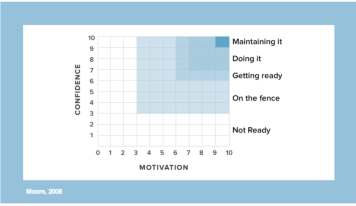
Jim Prochaska and his colleagues at the University of Rhode Island defined 5 stages in change: precontemplation (not ready, not aware, con’s are higher than the pro’s), contemplation (on the Fence, pro’s and con’s compensate themselves), preparation (Getting ready, pro’s start to outweigh the con’s), Action (doing it) and Maintenance (maintaining it). Research shows that 80% of us are in precontemplation or contemplation phase, no surprise it is so hard to change and achieve our goals.

2 main factors influence our ability to change (and therefore achieve our goals): Motivation (how bad do you want it?) and Confidence (how much do you believe in your ability to achieve it?)

Here is a graph from Margaret Moore which shows that to be more likely to change (achieve your goal), you need to be above 6 in motivation and confidence.

confidence motivation graph

So, when setting a goal, check-in with yourself: How motivated are you? and how confident you can achieve it are you? If you are not confident enough, ask yourself what do you need to feel more confident? You might also want to start with things where your confidence is higher, because achieving some goals will increase your confidence in being able to achieve other goals. And if you are not motivated enough, read the next paragraph.

3 sorts of motivations:

  • External: someone asking/telling you to do something. Obviously, this sort of motivation only is very limited.
  • Guilt (I should do this): this one might work but won’t lead to sustainable engagement.
  • Intrinsic (you really want to) à this is what you want to tap into. To do so, finding a clear WHY and asking yourself what will achieving your goal do for you will help.

Attached / Resigned cycle vs Commitment

When we set a goal, we are usually attached to achieving it no matter what, which might add some pressure or feel stressed when setting these goals. We might think that if we don’t achieve them, we are losers, we beat ourselves up and it will decrease our confidence. We move on to achieve them and then, when we don’t see the result we expect, when we have setbacks, when the deadline approaches, we fall right away into resignation. We don’t believe we can achieve them any more.

What I found very helpful was to come from a place somewhere else than on the attachment/resignation line, a place of Commitment. What are you committed to, no matter what and as long as the possibility exists? If you stay committed to something beyond your goals, 5, 10, 20 years from now (serving people, developing yourself, living an extraordinary life, etc…) and committed to do your work day after day, no matter if you reach your goal or not, you’ll be in a far better place. You’ll have created new things, you’ll have new experience, you’ll have grown. At the end of the day, no matter if you failed or not, you’ll have given it all. To me, Commitment is such a powerful thing.

Being vs Doing

We often think about what we need TO DO to achieve our goals, which is of course necessary, but rarely do we think about who we need to BE or BECOME: how do we show up in the world, what are our internal limiting beliefs, what are our fears, how our being is aligned with our doing? I found working on who I be in the world has been crucial for me so far. As I shared in my last 2018 post, I have achieved things in the past year but the most important, which outweigh the frustration to not have achieved more, is that I can feel some internal shifts which are the foundation for an even better year.

That’s it and that was long enough, so I will leave you with some questions: what do you want to create this year and further down the road? What would excite you most? What strategy are you going to set up, what mindset will you have? What support will you get?

Take care,

Evan

What’s that December Feeling?

Photo-by-Anton-Darius-@theSollers-on-Unsplash.jpg

Photo by Anton Darius @theSollers on Unsplash

There we go. December, end of the year, time for reflection and to start envisioning the next year…

This period can bring a mix of feelings: frustration to not have achieved all you wanted, pride for what you have actually achieved, eagerness to take a holiday break, excitement to start a new year, pressure to set new goals knowing you won’t achieve them all, etc…. And to some people, it can feel like a burden.

A few weeks ago, I started to feel tensed because we were approaching the end of the year and I knew I hadn’t achieved all I wanted. And as a high-achiever and driven person, I hate not achieving my goals. I felt frustrated. AND… I also knew it was OK. And I knew all this was just in my head. I needed to clear my mind.

So, I asked myself: how do I want to feel in this period? And how I wanted to feel was: complete and OK with this year whatever happened, at peace with myself, ready to enjoy that magical time with family and friends.

I then asked myself: what do I need to feel this way? And what I needed was not to check all my goals in details, I just needed to take a look at the big picture of my year, to catch the essence of what it had looked like, to feel OK with it and move on to what’s next.

I could extract the essence of my year:

  • On the DOING side, I achieved some important things (to me): I coached some awesome clients to move on toward what they REALLY want in their life, business, career, and I supported top athletes to perform to their best in collaboration with great coaches, I created new programs, I started and maintained to write consistently both about personal/professional development and sport mental preparation, I started to write a book on mental preparation.


  • On the BEING part, I am not the same person than I was at the beginning of the year. I invested more than ever in my own development, setting the foundations for an exponential growth. I did some transformational work with my own coach, attended intensives, joined a fantastic group coaching program. I explored vulnerability, developed even more confidence and leadership. My learning of different approaches such as ontological coaching (study of our being) and the neuro sciences behind coaching helped me understand how our mind and our brain are killing most of our possibilities, that our own limiting beliefs really get in our way to be both more Successful and more Fulfilled and that we can create whatever we want to create in our lives, should we sit with possibilities instead of killing them, be committed, perseverant, creative and patient.


So Now I feel complete for 2018 and relieved from the burden of goals review or goal setting, ready for whatever will show up in 2019. I’ll write more about this when we are there, but the words that come to me right now for 2019 are: discomfort (I need and want to get more uncomfortable since that’s where you really grow) and impossible (exploring the impossible).

To conclude, as one of my brilliant coaches put it recently in her invitation to let go of 2018:

  Your hands can do much more than just hold onto stuff. Free hands can create magic. See, if you had your hands full of stuff (whatever the stuff is), and I asked if you wanted a piece of delicious cake, and you wanted it, you would need to put down what you were holding, to free up your hands for whatever you wanted to receive, right?

  Even if you were holding something awesome, you’d still need to put it down to accept what I was offering you.

  Don’t get me wrong: sometimes we’re holding awesome stuff, and sometimes we’re holding old crap we don’t want: either way, the point is you can’t pick up anything new when your hands are full.

   This second week of December is going to focus entirely on you letting go of 2018, AS IS. This means that no matter what happened, or didn’t happen, you’re going to release it, call it done, and let it go.

  Again, why? Because then you will have free hands (remember the magic). And you will have space. Which is awesome, because you have a whole new year of new possibility ahead of you, and you will be able to put cool awesome things into all that empty space.

  Remember, you don’t have to let go of anything, ever (many people never do), but consider this your invitation to experience moving out of one year and into a new one with intention and space for what lies ahead.

 It feels like this is what I did in my own way. I am now moving into the Christmas season lighthearted, ready to enjoy time with family and friends back in France, ready to disconnect (yes, time without internet and no data on the cell phone!  OK, I will probably upload my emails and usual reads once in a while with whatever Wifi I will find, but overall it will be disconnected time) and ready to jump in 2019 with a lot of space for new exciting things.

So, what’s your December feeling? What do you want to do about it?

I wish you a wonderful holiday season and I’ll see you in 2019!

Take care,

Self-Esteem, Perspective and Perfectionism through an inspiring Golfer-Puppy Story

I recently read an article in the NYtimes about how Lexi Thompson, the leading American in the women’s golf rankings with a six consecutive years L.G.P.A. title streak, came back to her best after a slump with the help of …. her puppy.

Lexi Thompson had a complicated 2017 year, losing majors, suffering from social media pressure and dealing with personal issues in her family. She also had body-images issues leading to more stress. All this accumulated and led to a sort of burn-out.

When she started to come back, she took her new puppy companion, Leo, “a fluffy six-month-old, five-pound Havanese and miniature poodle mix” with her on the course. Here are 3 takeaways from this story that you can find in full HERE:

  • Self-Esteem comes from within, not from outside. The only way you’ll ever be truly happy,” she wrote, “is if you love yourself first” referring to her body-image issues and quest to look like fashion and fitness models. Build your self-esteem internally rather than just and always seeking external social approval. And know that it takes time and practice.
  • You need to separate yourself as a person from your sport performance. Your sport performance doesn’t define who you are. You are more than that. No matter what happens in the sport arena, you are a valuable person, a human being, doing his/her best, having family, friends, pets to love and to be loved from, going through life like anybody else. As Thompson said referring to her puppy: “No matter what I shoot, this guy is giving me kisses”. I really love this. It also reminds me of the Tennis Player Mischa Zverev who is used to watching his mum in the stands each time he makes a big mistake, because, he said, she is always smiling. Even if he is doing this to refocus (great example of a personal unique way to refocus), this also relates to the need to be reassured and know that even if we fail/don’t perform, we are still a valuable and loved person.
  • You are not perfect and that’s OK. As mentioned in the article: “It was instructive, Thompson said, to recognize that she loved Leo all the more because of his unruly ears, something others might see as a defect. On some level, it helped her realize how silly it was to invest so much energy in fixing or hiding flaws. “Yeah, exactly,Thompson said.I mean, everybody has imperfections. We’re all not perfect and we have to own it. Own it and love who you are.” It’s easy to say and yet so hard to really embody. I know it, I’m a perfectionist…

So, what are you taking away from this story?  What/Who is your “puppy Leo”?

Take care,

Are you a perfectionist?

Photo by Jonathan Hoxmark on Unsplash

I remember that when I was doing my first job interviews 20 years ago, I used to put perfectionist in my weaknesses actually thinking it was not such a bad thing (You know, you have to tell the interviewer your strengths and your weaknesses and usually you look for weaknesses that are not so terrible, right?).

But I actually didn’t see the real shadow of perfectionism. The more I move on in my coaching journey, doing my inner work, the more I realize the costs of being a perfectionist. You see, perfectionism is great, until it is not anymore. It usually puts you on a successful journey because you are doing a great job at anything you engage into. But when it becomes automatic and not a choice anymore, then it gets in the way for you to be even more successful and to go to the next level in your life or business.

When you are a perfectionist:

  • You want everything to be perfect so you spend hours fine tuning whatever you do, whereas you could actually spend this time elsewhere. You might even leave things in work, unfinished, because then there is always the possibility to correct or improve.
  • You overanalyze everything, trying to optimize and prepare for all that can go wrong and when things occur not according to plan, you get frustrated.
  • You are so afraid to make the wrong decision that you don’t make any decision, or it takes ages to make that decision.
  • You care too much about what people think about you (this is common to lots of people but being a perfectionist makes it even worth) and it holds you back.
  • You lack confidence because you don’t really see the good things you are achieving, you mainly focus on what could have been better.
  • Eventually, you don’t take risks, you don’t do what you are scared of, you don’t get uncomfortable. You move on a perfect conventional, linear path and you miss opportunities for deep learning, breakthroughs and exponential growth.

“No one is perfect” is a common saying but it has been overused. It can make a great excuse for not doing our best, not taking responsibility and not owning our imperfections. But getting clear on our imperfections, owning them and making a conscious choice about what to do with them, that’s where the breakthrough is.

So, are you a perfectionist? What are the benefits of it? What are the costs of it? Can you own your imperfections? What do you want to do with them?

You know what? I have been rereading and rewriting this post numerous times already, because of course I want it to be perfect 😊. And right now, I feel it is not, there is something I can’t quite articulate and I don’t like it. And this is why I am going to stop here and press send!

Take care,

Evan

The power of a smile

Photo by Capturing the human heart. on Unsplash

Photo by Capturing the human heart on Unsplash

One smile can change your experience in a moment.

We all have in mind some people who are naturally smiling, and we all know that it is pleasant. It makes us feel safe, included, and overall good. I talk about real smiles of course, not the fake ones.

A lot of us though, myself included, are often not smiling, mainly because we are in our head, with so many things in mind, because we are often in a fight or flight mode, being scared to be judged, to be taken advantage of, needing to look good, to not fail, and without realizing it, we just lose our ability to smile. Of course, when having a good time with friends, colleagues, family, we are smiling and even laughing. But how often is it in our daily activities?  I realized this during one of my meditations which ends with smiling. The first time I did it felt really awkward, I was definitely not comfortable although I was alone…You don’t believe me? Try to smile right now … OK, a little bit more now … come on you can do better! If you have the possibility to watch your face in a mirror, I bet you’re not even half way to your bigger smile. Let’s try a full deep smile…There we go 😊.

The good news is we can actually get better at smiling by practicing, like any other skill. And the benefits are real, for others but also for the one smiling. There is a growing body of research showing the benefits of smiling for our health but I want to focus on one thing here: there is a direct correlation between our smiling and our feelings. If you take some time to close your eyes and think of something pleasant, a positive experience, you might catch yourself naturally smiling. And the opposite is true. When you smile, your body reacts to it. When going under the cold shower after my workouts, I’ll smile and I can tell you it makes a huge difference in how I react to the cold temperature. It brings a feeling of appreciation to something that is naturally not pleasant.

But the better example I got is when plugging myself to a bio feedback system that I use to teach athletes (or business owners/managers) stress management techniques in order for them to stay composed and calm with a clear thinking in the face of adversity or stress. This device measures the heart rate and the goal of the techniques are to get into what is called a coherent state, different from being relaxed, where we are calm and composed inside while still alert and focused (these techniques and technology are used a lot with stressed professional in the military, the healthcare, the police and with athletes). When I am having a hard time getting in the green zone (coherent state), I reset my thinking and just smile, feeling appreciation. And I often get into the green right away. The smile is having an impact on my heart rate and my whole physiology, and I can really feel it.

What can we do with that?

When the kids get me crazy (surprising?), I sometime take a minute or 2 to isolate myself and smile, feeling the appreciation that goes with it. Smiling while being upset feels weird and awkward at first, but it really eases and accelerates the process to come back to a more neutral, calm state,  with a clearer thinking.

My invitation for you is to play with smiling: become aware of whether you are smiling or not, watch yourself in the mirror and practice, notice the impact on others (at work, in the street, at home) when you smile at them (usually, the other persons will smile too), feel what happens in your body when you genuinely smile, try to smile in unpleasant situations (it might be hard at first, you will feel your face really tensed but persevere and bring in that feeling of appreciation in the meantime) and notice what happens.

Finale note: don’t blame yourself when you don’t smile, that’s OK, you don’t have to smile all the time. The goal is to become more aware because, as I shared in a previous post, awareness leads to choice.

Get set, ready, smile!

Take care,

Evan

Work Life Balance? Try Work Life Swing

photo-by-brandon-wong-on-unsplash.jpg

Work Life balance is one of the most common struggles in today’s society. Almost everyone is trying to reach that balance and to maintain it. I am not discussing the fact that work is part of life and therefore we could question this expression, I just assume that what we mean by that is how we balance our personal and professional lives.

In a recent discussion I had, it appeared that the term balance might feel rigid, static, like it seems very hard or impossible to reach that equilibrium and even more to maintain it. A sense of frustration, stress and guilt might then show up as soon as moving away from this equilibrium, one way or another. As soon as we are making a move, we are unbalanced!

Photo by Aziz Acharki on Unsplash

A few days later, as I was meditating, this conversation came back to my mind. I was thinking about this rigid and stressful way of seeing work life balance, when I realized that the term balance has the same origin as the French word “se balancer” which means to swing (and the French word for a swing is “balançoire”). So, I started to envision work life balance as work life swing, a dynamic definition where you can swing from one side to another, where you get to choose the extreme point with the momentum you give to the swing. It takes away the sense of guilt or stress when you are giving more to one side, because you know it’s temporary and you will soon go back to the other side, effortlessly. It brings a sense of flexibility, of energy and freedom (If you haven’t been on a swing since you were a kid, do it, it’s really fun!) rather than a sense of struggle to constantly maintain a fragile balance. And it reminds us that life is a playground and we shouldn’t forget to have fun!

And, if you are very imaginative, you can even consider a “3D” swing like the ones with a donut shape (with a tire for instance), one fixation point at the top and which have a more circular move, not just one side to another but in many different directions which would represent different areas of your life (work, spouse, kids, friends, sport, music, etc…).

Eventually, this short reflection illustrates:

  • The power of words and language.
  • The power of shifting the paradigm or the context in which we are living. There is not One truth, we can create our own, one that fits with our values, needs and goals.

So, does the work life swing concept resonate with you? If not, what is YOUR paradigm for work life balance?

Take care,

Evan