Biathlon, the perfect blend of physical pain and mental focus

I’m fascinated by Biathlon, a sport which requires top endurance on the (cross country) skis and extreme focus when shooting, the perfect blend of physical pain and mental focus.

The season just ended last week-end with French Martin Fourcade winning a 7th overall crystal globe in a row, doing better than Norwegian legend Ole Einar Bjørndalen, and this just a few weeks after winning 3 Gold Medals in the recent Olympic Games in Pyeongchang, South Korea.

To understand a little bit more of what it takes to be a great biathlete and what mental skills are involved, here is an interesting article from the NYtimes:

How to manage Stress like an Olympic Biathlete

The keys the article mentions are the following:

  • Be prepared
  • Exhale slowly to reduce stress and increase alertness (when approaching the shot part)
  • Be mindful
  • Focus on the task, not the results.
  • Compete against yourself, nobody else.

This applies to many sports.

Despite how exhausting it is to be always so mentally focused throughout the season, Martin Fourcade has mastered these skills to a level that enabled him to be on the podium of 20 out of the 21 races of the season. The only one he failed to be on the podium was the very last one, when he had already won the overall crystal globe, the spring and the pursuit globes and just needed to finish 28th to win the mass-start globe.

“Unconsciously, when you have reached your goals and you know that you just need to finish 28th, it’s hard to do what it takes to win” said Martin Fourcade after the race. That makes you realize the power of the mind. In a positive way … and in a negative way.

 A statement that says it all.

Take care,
Conversational Intelligence, the Neurochemistry of Trust and Successful teams and organizations

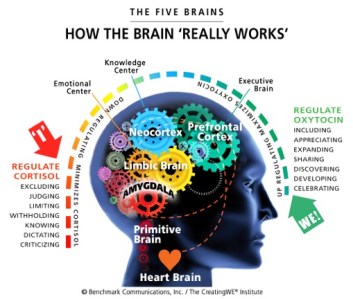
HOW-THE-5-BRAINS-WORK

I have worked in various corporate organizations and observed that what we call the soft skills are actually the harder to get and the ones with the most significant impact on the organization’s success. This is one of the reasons I transitioned to coaching. And this is why I was trained at Conversational Intelligence which I would like to introduce today.

“To get to the next level of greatness depends on the quality of the culture, which depends on the quality of relationships, which depends on the quality of conversations…”   (Judith E. Glaser).

Developed by Organizational Anthropologist and Executive coach Judith E. Glaser, by whom I had the pleasure and honor to be trained, Conversational Intelligence® (C-IQ), a new and innovative framework, is the hardwired, and learnable ability to connect, navigate and grow with others – a necessity in building healthier and more resilient organizations in the face of change.

Whereas EQ is mainly about self-regulation (I-centric), C-IQ is about Co-regulation (WE-centric). C-IQ begins with TRUST, and ends with high quality relationships and business success.

In school we learn grammar and punctuation, but where do we learn to really have difficult conversations? Some people may have it naturally or gain it over the years, but they don’t really get taught that anywhere along the way. And this is what C-IQ really does for you – it teaches you how to have these conversations, to stop avoiding them, to connect with people, build the relationships that result in TRUST. When we trust each other, we can learn together even through change and difficult tasks.

Conversational Intelligence is about COMMUNICATION

Research show that 9 out of 10 conversations miss the mark.

“I know that you believe you understand what you think I said, but I am not sure you realize that what you heard is not what I meant.”

– Robert McCloskey during a Press Briefing about the Vietnam War

 Conversational Intelligence is about TRUST

Google learned From its Quest to Build the Perfect Team (NY Article HERE) that the best teams had:

– conversational turn-taking = equal time of talking by team members

– average social sensitivity = empathy, sensitivity towards colleagues

This is the concept of psychological safety which is to allow space to speak up and take risks.

Conversational Intelligence is about NeuroSciences

It gives us insight into how our brain responds during conversations and how conversations activate our trust and distrust networks in our brain. Conversational Intelligence elevates Oxytocin, the chemistry of Connection, and lowers Cortisol, the chemistry of fear and distrust.

What is great with this is that it is not limited to the workplace, it can be applied in the education system, in personal relationships or in sport teams.

Take some time to think about the level of trust in your team or organization. How high or how low is it? How is the quality of the conversations? Of the relationships? How is it impacting the team or organization’s efficiency?

Take Care,

Evan


How to deal with negative self-talk in sport?

self-doubts.jpg

Photo by Christopher Campbell on Unsplash

Do you, your kid or your athletes have negative self-talk?

I suck, I am going to fail as usual, I don’t belong, I can’t beat him, we can’t win that game, what if I make a mistake?, I don’t feel great today”, …  Sounds familiar?

All these negative self-talks are a very common issue with athletes. For a reason: our brain is wired in a way that will always fear for the worse. When we are having these thoughts, we act from the amygdala in the primitive lower brain, (responsible for the fight or flight mode). This actually leads to releasing cortisol which will feed even more this reaction entering into a negative spiral. It is therefore very important to be able to identify as soon as possible that spiral and break it.

So, how do you that? Here are some tips:

  • Identify the negative self-talk (awareness)
  • Be specific in your self-talk to avoid seeing you bad as a whole
  • Challenge your talk:
    • what do you know for sure?
    • Can you really predict what’s going to happen? (hint: actually no)
    • Remember a time when you had this negative self-talk and things happened to go well
  • Relabel it as temporary: it’s no more than thoughts and emotions that will go away.

Other more advanced techniques such as visualization, emotion management techniques, power words can help to switch from negative self-talk to positive self-talk and can be learned and practiced with a mental game coach or sport psychologist.

The importance of Mental resilience with Snowboard cross Olympic Gold medalist Pierre Vaultier

Pierre Vaultier is a French Snowboarder who just won his 2nd Olympic Gold medal in snowboard cross in the 2018 Winter Olympics in PyeongChang after the one he had got in Sotchi 4 years ago. This athlete has earned his successes with some undeniable natural talent, hard work (Kevin Strucl, manager of the France snowboardcross team: “He is such a hard worker in practice, if he doesn’t train for a week, he thinks he lost all his abilities. He trains more than others and he has had a little extra talent others don’t have since he was born) but also with a high mental resilience (ability to let go of setbacks to focus on what’s next).

In Sotchi 4 years ago, he had arrived with a missing cruciate ligament and wearing a splint after he had injured himself 2 months before the Olympics. An audacious (not to say crazy) bet. But he was able to let go of his accident and the associated fear of falling again, of the fact that he didn’t have a “normal” and strong knee, to reach the final and win the Gold.

This year in PyeongChang, Pierre Vaultier fell and even unfixed his snowboard in the semifinal but was able to finish 3rd and qualify for the final.

Pierre Vaultier: “The Australian Jarryd Hughes took a bad curve and put us all down. I unfixed my snowboard, it’s bad luck but it’s good luck that I could start again. This was totally unexpected and a mess. To fall and qualify is rare. To fall, unfix and qualify is even more uncommon.  I thought I was out”. 
Then to prepare the final: “My coach gently told me I was under a lucky star today and that there was no way I could choke in the last run” he explained. “That it was a lucky one but that I deserved this finale. That motivated me. I told myself: Now, you stand up and you blow everything”. 

After falling in semifinal, all sort of thoughts could have distracted him. He could (and he may) have had negative self-talks like “this is not a good day, I’m not going to make anything in the final”, he could have lost confidence in his skills, he could have thought he didn’t deserve to be in final, etc. …. But he was able to let go of them and refocus on what he does best: snowboarding. He then took the lead early on in the final and went to win the gold medal.

No matter what your sport is, practice being resilient each time you are having a setback, whether in practice, in games, in competition. It can be after not feeling well during a qualification race, or missing a penalty early on in a soccer game.

The past can’t predict the future so let go of what happened and focus on the task at hand.

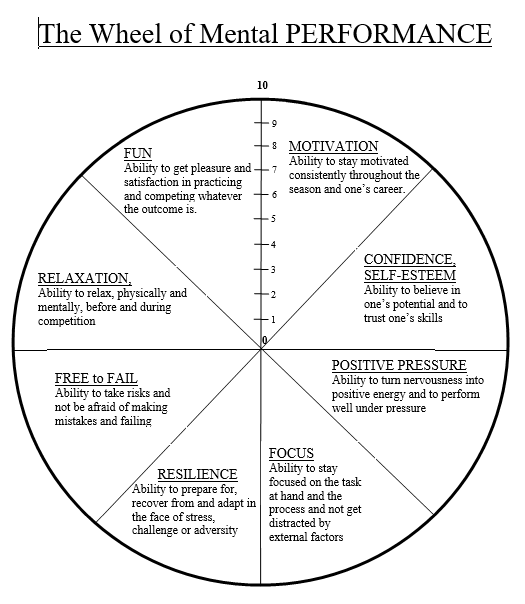
The Wheel of Mental Performance

pexels-photo-171198.jpeg


Do you want to know where to start to improve your performance?

Here is a tool that I created as a way for the athletes to assess themselves and visualize some key mental skills. It’s called the wheel of mental performance.

Wheel of mental Performance seule avec titre

Take the time to assess yourself, or to have your athletes assess themselves, with honesty by ranking your level in each skill between 0 (center of the wheel) and 10 (Current perimeter of the circle) and draw a line corresponding at that level in the associated area. The new contour will give you a visual representation of your Mental Performance.

Review results and make note of any insights that are revealed.

What did you learn?

What could happen if you were to improve some of these skills ?

Take Care,

Evan

Awareness leads to Choice and Choice leads to Change

Awareness leads to Choice …

… and Choice leads to Change

Since the beginning of my journey as a coach, this quote has been one of the most important for me and has been very impactful with some clients.


Imagine you are in a boat going down the river of life but you don’t have anything in the boat to control anything, neither the global route, neither the instantaneous direction, neither the speed. You are just going where it takes you.

Then you put some magical awareness glasses on.

Now you can see that you have a map in the boat, to help you see where you are, where you want to go and one main logical way to get there. If you keep your glasses on longer and go deeper, you can actually see many other ways and you can choose the one that best suits you.

Now you see you there is an engine that will help you speed up when you want (when inspired, full of energy etc…) or slow down when you need (never thought you would need a break?), even stopping on the bank to enjoy.

You can also see that you have a rudder to orientate your boat and avoid crashing on some rocks, someone else’s boat, or take a path that seems easier, faster or more fun.

The first step is therefore to find and wear your magical awareness glasses as often as possible. Increasing awareness requires some self-reflection, might require to press the pause button in your life. But just like practicing a sport, an instrument or learning at school or in your job, the more you practice developing your awareness the more it becomes easy and natural.

Then, as soon as you become aware of a situation, of a pattern in your behavior, of your impact (which might be different from your intention), of your procrastination, of something you should stop, aware of your thought, of your emotions, … then you have a choice:

  • Either to change (and it might not be easy)
  • Either to stay in the same situation

There are no right or wrong answers, just a choice… meaning that we have much more control than what we often think. Sometimes, we are on automatic pilot after years of habits and are not even aware of our reactions or behavior. Sometimes we are aware but tell ourselves stories, find excuses to justify our actions or inactions. With our thoughts and emotions, it might be even harder since they can be very quick and intense, but we still have a choice to let them take control or not.

Knowing that awareness leads to a wider menu of choice is very empowering, expand the possibilities for action, which in turn leads to a higher likelihood of successful results and at the end, to a more intentional life.

Take some time to reflect on this and let it sink in. Maybe it will click right now, maybe in some days, or even in some months…

Take care and happy Christmas time !

Evan


How Much of Performance is Mental and what can you do about it?

When you ask athletes: “How Much of Performance do you think is mental?”, most often they answer between 50% and 90%.

I personally prefer seeing it the following way: to be at our best, ie 100% performant, we need to be at 100% on the physical side and at 100% on the mental side.

Generally, there is an agreement that the mental side has some significant impact on performance.

Now, when you ask them “How much of your time do you spend practicing the mental side?”, the answer is often “not a lot”.

So where does that gap come from? Here are several possibilities:

  • Some might think the mental side is something you have or you don’t have (confidence, focus, motivation, etc…)
  • Some might think they are already doing mental training just because they read or hear things like: “Common, you can do it, be strong!”, “you have to focus”, “just trust yourself”, “relax.”, “don’t be so nervous”.
  • Some might think this is just for top level athletes
  • Some might not really know what it is and how to practice

Here is what we can say about mental training

  • Our thoughts and emotions are impacting our performance, whether we are aware of it or not. The first step in mental training is to become aware of what we think, how we feel, and recognize how this might affect our performance. Yet this is not easy, in a world where we are supposed to be tough, not show our emotions, concerned about what other think etc…

  • Mental training is like taking our brain to the gym, it does for the brain what stretching and strengthening do for the body. When you practice mental training, you actually stretch the way you are looking at your performance and the possibilities offered by any situation, positive or negative; you learn and strengthen the ability to turn nervousness into positive energy, to focus, to relax, to bounce back after setbacks, to feel confident, to play well under pressure (and to like it!), so that you perform at your full potential… These are skills that can be learned.

  • A growing body of research shows the benefits of different techniques like mental imagery or other technique directly impacting our emotions, heart rate and overall physiology. This is a global mind/body/spirit approach that also translate into everyday life.

  • Now, as everything in life, it requires commitment and practice. As Thich Nhat Hanh puts it about meditation, “it is not a matter of faith, it is a matter of practice”. Knowing or believing is not enough, you have to learn and then practice on a regular basis.

  • Mental training is for anyone. Any athlete, whatever the sport, whatever the level, is human and therefore has thoughts and emotions that are compromising their full potential.

In the coming months, I’ll try to give valuable tips and illustration of the value of mental training.

Take care,

Evan


People live from their perception

People live from their perception

This is one of the guiding principle I learned when trained to become a coach. We all live from our perception of a reality that we see and interpret through our personal filter determined by our beliefs, our past experience, our values, our fears, etc… This is natural and what is important is to become aware of it in order to remain as open minded as possible, to avoid a potential lack of understanding of other people and to be less judgmental. This also helps us as coaches to more easily let the coachee find his own solutions rather than bringing our own solution.

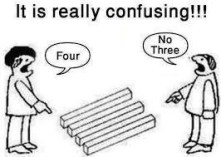
Here are some illustrations, because sometimes pictures speak better than words:

Confusing

So, who’s right?

If each person were open-minded enough to go and see from the other person’s perspective, they would be more likely to think: OK, this is not as clear as I thought, he may be at least as right as I am…”

Watch the following image. What do you see?

Lady young or old

A young lady or an old woman ? (the right eye of the old woman is the right ear of the young lady and the nose of the old woman is the chin of the young lady)

This is a well-known example but this illustrates very well that the reality can be seen and interpreted very differently. We can see a young lady or an old woman. And even if we both see an old lady, do we think she is sad, scary, neutral? This is the case for about anything in life.
For instance:

  • Last year, my younger son became upset when his 2 elder brothers did not want to show him what they were doing because they actually were preparing him a surprise. Even when they explained to him that they were making him a surprise, he didn’t calm down, still feeling hurt of being excluded, maybe because he did not really understand the goal of the ongoing action or maybe because he understood but it was more important for him to be part of the group and participate rather than to get a surprise. Each one had a good reason to react the way they did and only the difference in their perception of the situation led to the dispute. That’s when Dad had to say “OK guys, come on and let’s talk” …
  • Another example in the corporate world: some managers might be very directive because they have always been in a directive environment and they consider it effective and a proof of leadership but their employees might see that as a lack of trust and empowerment toward them. And vice versa, some employees might see their “not directive” manager as lacking authority, or indecisive. All this depending on their past experience and internal beliefs.

Uncovering these gaps in perception is key to create the best outcome possible in our relationships and therefore in our personal life or business. It doesn’t mean we have to approve the others’ point of view but to be open-minded and acknowledge this different perception without judgment, which allows for more possibilities in the end.

How is the perception of your employees, you colleagues, your boss, your clients, your friends, different from yours?
What are you 100% sure (and is there actually anything that you are 100% sure) and what is based on your personal filter?
What can you do about it?


I don’t need a coach

business-man-again-1438677

“I don’t need a coach”.

That’s what I thought when reading the title of an article about coaching about 10 years ago. It was even worse, I thought “who would need a coach?”, full of judgment and thinking that people hiring coaches were just not strong enough to get their job done on their own. Being a competitor since I had been a swimmer at national level back in my high school and college year, and a high achiever since then in my career, I was seeing hiring a coach as a sign of weakness, thinking proudly: I can take care of myself, of my career, of my life. I actually couldn’t be further from the truth, for 3 reasons:

  • Number 1: I learned that getting some help from others was not only OK but was just smart and makes your journey much easier. I learned that vulnerability was not a weakness but a strength. In a world where we are expected to know everything (from our youngest age at school to the work place), I realized that asking questions could be more powerful than providing answers and advice, as very well illustrated in a “More Beautiful Question” by Warren Berger.
  • Number 2: I thought I didn’t need anyone to make me move forward …. But actually, I realized that having someone challenge me, inspire me have me make promises and be accountable to them was making a huge difference in the efficiency and the speed of the actions I needed to take and that I often kept postponing for all the good reasons I could find.
  • Number 3: I actually didn’t know what coaching was. I imagined someone coming to tell me what I should do, and no one really likes to be told what to do. But when I was first introduced to coaching, I discovered a completely different story:
    • When being coached, I was asked questions rather than told.
    • I felt heard, not judged, supported and most of all safe. I realized there was actually no space in our lives where we could process our thoughts without the fear of being judged or having to justify ourselves.
    • I observed that just talking through my challenges or goals, and having someone rephrase or re frame what I said, helped me get clearer on what my needs really were (and they are often not exactly what we think they are).
    • It helped me see my blind spots, which I actually didn’t know I had (this is the tricky thing, until someone helps you see them, you are not aware of them…).
    • I learned to see things from a different perspective, to challenge my beliefs, to think bigger, to open up to new possibilities.
    • Eventually I learned that “Awareness Leads to Choice and Choice leads to Change”, an empowering statement that I recommend everyone to keep in mind every day.

For all these reasons, I now know that I still don’t need a coach but, to increase my Awareness and take Actions toward my goals and dreams, I want one (and I have one).

Take care,

Evan