3 parallels between the Aerospace Industry and Sport

Rocket

I’d like to start this Sport Mental Game Coaching year by sharing 3 parallels I made between my experience in the aerospace industry and sport.

  1. Be prepared and ready and focus on what you can control to boost your confidence

As a swimmer, I used to lack confidence in competition. And as I started my career as engineer and quickly project manager in the space industry and for the French and European Space agencies, I had that same lack of confidence at first. I built it with experience of course. But I noticed one thing. The more prepared and the readier I was, the more confident I was. When I had to present and defend a certain position, if I had reviewed all my technical points, prepared my argument, prepared for the questions that might be asked, I was feeling confident. If I was not completely clear, if I had doubts, if I had failed to analyze something, I was not confident. And the more I focused on what I could control (my analyses, my actions, my presentations, etc…) rather than worry on things I couldn’t control (what if something new shows up, what if someone doesn’t understand what I explain, etc…), the more confident I was.

This is the same in sport: if you are prepared (you know you trained well physically, technically, strategically and mentally, you rested well, you ate well), if you feel ready to just do what you have learned, if you don’t let room for doubts, AND don’t focus on what you cannot control (the other opponent, the weather, the referee, what people will think, even just the outcome), then you will be more confident.

  1. Differentiate yourself from your sport and performance

When you work on Rocket launches, you can feel like the whole launch’s success is in your hands…Even if you work on small part of the program, even if you are not the only one to check and validate. It feels like one error can lead to a failure. And it can be overwhelming. It feels like your whole life depends on what’s going to happen. So, I learned to differentiate myself as a person from my job and work. I learned to remind myself that I was just a guy doing his best, doing his part of the job, and that no matter what would happen, I would still be a good person, with another part of my life still there, with family and friends to care for and to be cared from.

When we are passionate and competitive, our sport can take all our mental space. And as soon as we lose, we feel like our whole person is a loser, failed, disappointed others. And it can be devastating, specifically at a young age. So, my invitation for you is to remind yourself as often as possible that, no matter what happens, your sport performance doesn’t define you. You are more than that and if you feel not good enough, that you are less than others, just know that this is not true. There are parts of you, strength, qualities that others don’t have, that may not be seen in your sport and performance and that make you an awesome person overall. It doesn’t mean you shouldn’t want to improve and develop certain qualities and be ambitious, just that you should see the whole picture.

  1. Have Fun

I remember difficult times when we had to work late and hard to clear a launch. It can be draining on the long run. Bringing some fun helped recharge, stay motivated and focused and move on. Even in the tough times, you want to allow some moments of fun, to take the pressure of.

This is the same in sport. If you forget to have fun, you won’t last. If you forget to have fun, you won’t even play at your full potential. If you forget to have fun, what’s the point in training so hard?

Take care,

VISION, STRATEGY and MINDSET to Support Goal Setting

photo by richard felix on unsplash

I wish you and Happy and Healthy New Year, with lots of personal fulfillment and professional achievements. I wish you to be intentional in what you want to create in your life, business, career, relationship….

 I want to start the year by sharing a few things around Goal Setting (sorry this is a rather long one).

First, I don’t like to do as everyone and part of me didn’t want to talk about goals because that’s what everyone is talking about at the moment, and yet, as I thought about it, I couldn’t find a reason good enough to not talk about it, because goal setting is really important if you want to create a life by design where you are intentional about what you want and how to get it, as opposed to a life by default where you just go where life takes you.

Note 1: there is nothing wrong with the latter, but I find it so much more exciting and inspiring to create the life I (and my family) want.

Note 2: we might think we are in control and intentional in our lives but what I discovered when engaging in my coaching journey is that there is much, much, much (yes 3 times) more that we can choose and create than we think.

There is no right way to set goals and follow through and I’ll just share some pieces of information and experience to hopefully help you find your own way to set a direction for this new year. My perspective is that Goals are just a tool as part of the Strategy to get from where we are in the Present, to our Vision. And to get to our Vision, we also need to work on our Mindset. So here we go with Vision, Strategy and Mindset.

VISION

To create your vision, you may ask yourself 2 very simple questions:

  • What would you like?  5, 10, 20 years from now? No censorship. We are pretty good at envisioning what we think we can get but not what we really want.
  • What would having that do for you? This is a key question to i) know why you are doing this ii) uncover some hidden desire/needs that you can actually start working on right now, without waiting to have achieved you primary goal/vision.

STRATEGY

  • Break down: your vision and long term goals into yearly goals, then into quarterly goals, and then in weekly/daily actions and habits. And don’t be attached to achieving the plan exactly how it is (see further in this post). The idea is to see that you can actually bridge the gap between now and your vision, and to start/continue to move into that direction.
  • Set 90 days goals: I like this time frame. Yearly goals are too far away and are less manageable. With 90 days goals, I can tweak my strategy/direction 4 times a year and take actions that are more focused.
  • Look at every area of your life: business, finance, health, relationships, spiritual, fun. How satisfied are you in each of these? Which ones do you want to focus on in the next 90 days. You can use the Wheel of Life.
  • Outcome Goals vs Process Goals
    • An outcome goal is a goal focused on a result: I will get X clients, I will make X amount of money, I will change job, I will run a marathon (in a certain time) etc… These goals are inspiring, motivating but are also adding pressure since we might feel we have to achieve them and if we don’t, it means we failed and we beat ourselves up. And these goals are usually not 100% in our control.
    • A process goal is a goal focused on a recurring action such as: I will meet X new people per week, I will interview X persons per month about a certain job type, I will run X times a week. These goals are usually in our full control and are part of the strategy to achieve our outcome goals and Vision.

I personally like to mix inspiring motivating outcome goals and practical process               goals.

  • Simplification/prioritization: if you have too many goals, simplify and prioritize, at least for the short term. Yes, it can be hard, it means you have to say No to some things…
  • Structure: writing the goals down is great, but what will have us achieve them is to take action. To do so, I like to set a clear structure, which took different forms throughout the years: it may be a short-term plan in an excel file, with goals in horizontal and weeks in vertical, putting the intended results and then the needed actions backwards, then reviewing this every week to check how it went and plan for the next one. IT may be by setting a regular weekly structure (every week looks the same, in my case, with time to write, time to coach, time to connect, time to learn/train etc…). Or it might be using some apps (I’m sure there are tens of them out there). Eventually, I found morning and end of the day routines help staying intentional, focused and on track, with a positive experience.
  • Follow-up, track and evaluate: I feel resistance to do that because, to be honest, it has me face reality sometime (am I putting in the work, the time, the energy, am I getting results, etc.?) but this is key.
  • Support: we are humans and we are wired to not change (this brings uncertainty and our brain doesn’t like that), we have fears, doubts, ups and downs and we sometime don’t even clearly know what we want. If you want to be efficient, move on faster and further, get some support: be part of a support group, hire a coach, use accountability partners (although the impact is limited to … accountability 😊).


MINDSET

 Possibility: our brain is very good at killing any possibility as soon as it is born. Where there is possibility, there is fear, uncertainty. So, your job is to keep the possibility alive. I had to practice being present to the possibility for myself and for my clients. When you work on your vision, don’t censor anything, write down what you really want (another way to frame it can be: “wouldn’t it be cool if …”) and then, when your brain starts to find all the reasons why it’s impossible, when you can’t find the path to get there right now, don’t kill the possibility, just leave it there and start taking tiny steps in that direction. Live in possibility.

 The 5 stages of behavioral changes:

Jim Prochaska and his colleagues at the University of Rhode Island defined 5 stages in change: precontemplation (not ready, not aware, con’s are higher than the pro’s), contemplation (on the Fence, pro’s and con’s compensate themselves), preparation (Getting ready, pro’s start to outweigh the con’s), Action (doing it) and Maintenance (maintaining it). Research shows that 80% of us are in precontemplation or contemplation phase, no surprise it is so hard to change and achieve our goals.

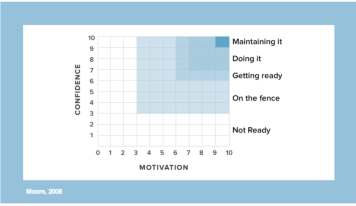
2 main factors influence our ability to change (and therefore achieve our goals): Motivation (how bad do you want it?) and Confidence (how much do you believe in your ability to achieve it?)

Here is a graph from Margaret Moore which shows that to be more likely to change (achieve your goal), you need to be above 6 in motivation and confidence.
confidence motivation graph

So, when setting a goal, check-in with yourself: How motivated are you? and how confident you can achieve it are you? If you are not confident enough, ask yourself what do you need to feel more confident? You might also want to start with things where your confidence is higher, because achieving some goals will increase your confidence in being able to achieve other goals. And if you are not motivated enough, read the next paragraph.

3 sorts of motivations:

  • External: someone asking/telling you to do something. Obviously, this sort of motivation only is very limited.
  • Guilt (I should do this): this one might work but won’t lead to sustainable engagement.
  • Intrinsic (you really want to) à this is what you want to tap into. To do so, finding a clear WHY and asking yourself what will achieving your goal do for you will help.

Attached / Resigned cycle vs Commitment

When we set a goal, we are usually attached to achieving it no matter what, which might add some pressure or feel stressed when setting these goals. We might think that if we don’t achieve them, we are losers, we beat ourselves up and it will decrease our confidence. We move on to achieve them and then, when we don’t see the result we expect, when we have setbacks, when the deadline approaches, we fall right away into resignation. We don’t believe we can achieve them any more.

What I found very helpful was to come from a place somewhere else than on the attachment/resignation line, a place of Commitment. What are you committed to, no matter what and as long as the possibility exists? If you stay committed to something beyond your goals, 5, 10, 20 years from now (serving people, developing yourself, living an extraordinary life, etc…) and committed to do your work day after day, no matter if you reach your goal or not, you’ll be in a far better place. You’ll have created new things, you’ll have new experience, you’ll have grown. At the end of the day, no matter if you failed or not, you’ll have given it all. To me, Commitment is such a powerful thing.

Being vs Doing

We often think about what we need TO DO to achieve our goals, which is of course necessary, but rarely do we think about who we need to BE or BECOME: how do we show up in the world, what are our internal limiting beliefs, what are our fears, how our being is aligned with our doing? I found working on who I be in the world has been crucial for me so far. As I shared in my last 2018 post, I have achieved things in the past year but the most important, which outweigh the frustration to not have achieved more, is that I can feel some internal shifts which are the foundation for an even better year.

That’s it and that was long enough, so I will leave you with some questions: what do you want to create this year and further down the road? What would excite you most? What strategy are you going to set up, what mindset will you have? What support will you get?

Take care,

Evan

What’s that December Feeling?

Photo-by-Anton-Darius-@theSollers-on-Unsplash.jpg

Photo by Anton Darius @theSollers on Unsplash

There we go. December, end of the year, time for reflection and to start envisioning the next year…

This period can bring a mix of feelings: frustration to not have achieved all you wanted, pride for what you have actually achieved, eagerness to take a holiday break, excitement to start a new year, pressure to set new goals knowing you won’t achieve them all, etc…. And to some people, it can feel like a burden.

A few weeks ago, I started to feel tensed because we were approaching the end of the year and I knew I hadn’t achieved all I wanted. And as a high-achiever and driven person, I hate not achieving my goals. I felt frustrated. AND… I also knew it was OK. And I knew all this was just in my head. I needed to clear my mind.

So, I asked myself: how do I want to feel in this period? And how I wanted to feel was: complete and OK with this year whatever happened, at peace with myself, ready to enjoy that magical time with family and friends.

I then asked myself: what do I need to feel this way? And what I needed was not to check all my goals in details, I just needed to take a look at the big picture of my year, to catch the essence of what it had looked like, to feel OK with it and move on to what’s next.

I could extract the essence of my year:

  • On the DOING side, I achieved some important things (to me): I coached some awesome clients to move on toward what they REALLY want in their life, business, career, and I supported top athletes to perform to their best in collaboration with great coaches, I created new programs, I started and maintained to write consistently both about personal/professional development and sport mental preparation, I started to write a book on mental preparation.


  • On the BEING part, I am not the same person than I was at the beginning of the year. I invested more than ever in my own development, setting the foundations for an exponential growth. I did some transformational work with my own coach, attended intensives, joined a fantastic group coaching program. I explored vulnerability, developed even more confidence and leadership. My learning of different approaches such as ontological coaching (study of our being) and the neuro sciences behind coaching helped me understand how our mind and our brain are killing most of our possibilities, that our own limiting beliefs really get in our way to be both more Successful and more Fulfilled and that we can create whatever we want to create in our lives, should we sit with possibilities instead of killing them, be committed, perseverant, creative and patient.


So Now I feel complete for 2018 and relieved from the burden of goals review or goal setting, ready for whatever will show up in 2019. I’ll write more about this when we are there, but the words that come to me right now for 2019 are: discomfort (I need and want to get more uncomfortable since that’s where you really grow) and impossible (exploring the impossible).

To conclude, as one of my brilliant coaches put it recently in her invitation to let go of 2018:

  Your hands can do much more than just hold onto stuff. Free hands can create magic. See, if you had your hands full of stuff (whatever the stuff is), and I asked if you wanted a piece of delicious cake, and you wanted it, you would need to put down what you were holding, to free up your hands for whatever you wanted to receive, right?

  Even if you were holding something awesome, you’d still need to put it down to accept what I was offering you.

  Don’t get me wrong: sometimes we’re holding awesome stuff, and sometimes we’re holding old crap we don’t want: either way, the point is you can’t pick up anything new when your hands are full.

   This second week of December is going to focus entirely on you letting go of 2018, AS IS. This means that no matter what happened, or didn’t happen, you’re going to release it, call it done, and let it go.

  Again, why? Because then you will have free hands (remember the magic). And you will have space. Which is awesome, because you have a whole new year of new possibility ahead of you, and you will be able to put cool awesome things into all that empty space.

  Remember, you don’t have to let go of anything, ever (many people never do), but consider this your invitation to experience moving out of one year and into a new one with intention and space for what lies ahead.

 It feels like this is what I did in my own way. I am now moving into the Christmas season lighthearted, ready to enjoy time with family and friends back in France, ready to disconnect (yes, time without internet and no data on the cell phone!  OK, I will probably upload my emails and usual reads once in a while with whatever Wifi I will find, but overall it will be disconnected time) and ready to jump in 2019 with a lot of space for new exciting things.

So, what’s your December feeling? What do you want to do about it?

I wish you a wonderful holiday season and I’ll see you in 2019!

Take care,

Self-Esteem, Perspective and Perfectionism through an inspiring Golfer-Puppy Story

I recently read an article in the NYtimes about how Lexi Thompson, the leading American in the women’s golf rankings with a six consecutive years L.G.P.A. title streak, came back to her best after a slump with the help of …. her puppy.

Lexi Thompson had a complicated 2017 year, losing majors, suffering from social media pressure and dealing with personal issues in her family. She also had body-images issues leading to more stress. All this accumulated and led to a sort of burn-out.

When she started to come back, she took her new puppy companion, Leo, “a fluffy six-month-old, five-pound Havanese and miniature poodle mix” with her on the course. Here are 3 takeaways from this story that you can find in full HERE:

  • Self-Esteem comes from within, not from outside. The only way you’ll ever be truly happy,” she wrote, “is if you love yourself first” referring to her body-image issues and quest to look like fashion and fitness models. Build your self-esteem internally rather than just and always seeking external social approval. And know that it takes time and practice.
  • You need to separate yourself as a person from your sport performance. Your sport performance doesn’t define who you are. You are more than that. No matter what happens in the sport arena, you are a valuable person, a human being, doing his/her best, having family, friends, pets to love and to be loved from, going through life like anybody else. As Thompson said referring to her puppy: “No matter what I shoot, this guy is giving me kisses”. I really love this. It also reminds me of the Tennis Player Mischa Zverev who is used to watching his mum in the stands each time he makes a big mistake, because, he said, she is always smiling. Even if he is doing this to refocus (great example of a personal unique way to refocus), this also relates to the need to be reassured and know that even if we fail/don’t perform, we are still a valuable and loved person.
  • You are not perfect and that’s OK. As mentioned in the article: “It was instructive, Thompson said, to recognize that she loved Leo all the more because of his unruly ears, something others might see as a defect. On some level, it helped her realize how silly it was to invest so much energy in fixing or hiding flaws. “Yeah, exactly,Thompson said.I mean, everybody has imperfections. We’re all not perfect and we have to own it. Own it and love who you are.” It’s easy to say and yet so hard to really embody. I know it, I’m a perfectionist…

So, what are you taking away from this story?  What/Who is your “puppy Leo”?

Take care,

TRUST, CONFIDENCE, TOUGHNESS in Sport

Trust Confidence Toughness

One athlete recently shared with me 3 words she regularly reminds herself of: Trust, Confidence and Toughness. I thought that was a great example of Power Words.

I love these words because they capture many different things all together (which, by the way, may not be exactly what these words meant to this athlete):

  • Trust: it captures the fact that at some point you need to commit yourself to the unknown and to the fact that you cannot control everything. It helps being OK with whatever happens and being detached from the outcome.
  • Confidence: it captures the more inward feeling of believing in yourself, based on what you have previously accomplished and on what you know is true about yourself despite your inner critic and negative thoughts.
  • Toughness: yes, sport is tough. Whether it’s physically through the pain of pushing oneself, through contacts in some sport and through injuries, or mentally when pressure is high and a lot is at stake, during downs in results, when being on the bench in a team sport etc… Being OK with the toughness of your sport will help better deal with it.

Other power words, depending on your personality and on what you may want to improve, could be Relax, Focus, Fun, Energy, Ease.

Words may mean or remind different things to different persons. Pick whatever words which resonate with you and help you be at your best. And really feel and embody their meaning (as opposed to just think about them): if you are reminding yourself of confidence, really embody that, remember your past peak performance to reinforce this feeling, not just believe, know you can make it. If your power word is Relax, really relax physically (your muscles) and mentally (create some space in your mind, slow down etc…). If it is Energy, you may for instance feel a warm and yellow/orange light in your body or sensations of being energized.

Just be creative with your words and feelings. And remind yourself of your power words when practicing, preparing or competing.

So, what are your Power Words?

Take care,

Evan

Are you a perfectionist?

Photo by Jonathan Hoxmark on Unsplash

I remember that when I was doing my first job interviews 20 years ago, I used to put perfectionist in my weaknesses actually thinking it was not such a bad thing (You know, you have to tell the interviewer your strengths and your weaknesses and usually you look for weaknesses that are not so terrible, right?).

But I actually didn’t see the real shadow of perfectionism. The more I move on in my coaching journey, doing my inner work, the more I realize the costs of being a perfectionist. You see, perfectionism is great, until it is not anymore. It usually puts you on a successful journey because you are doing a great job at anything you engage into. But when it becomes automatic and not a choice anymore, then it gets in the way for you to be even more successful and to go to the next level in your life or business.

When you are a perfectionist:

  • You want everything to be perfect so you spend hours fine tuning whatever you do, whereas you could actually spend this time elsewhere. You might even leave things in work, unfinished, because then there is always the possibility to correct or improve.
  • You overanalyze everything, trying to optimize and prepare for all that can go wrong and when things occur not according to plan, you get frustrated.
  • You are so afraid to make the wrong decision that you don’t make any decision, or it takes ages to make that decision.
  • You care too much about what people think about you (this is common to lots of people but being a perfectionist makes it even worth) and it holds you back.
  • You lack confidence because you don’t really see the good things you are achieving, you mainly focus on what could have been better.
  • Eventually, you don’t take risks, you don’t do what you are scared of, you don’t get uncomfortable. You move on a perfect conventional, linear path and you miss opportunities for deep learning, breakthroughs and exponential growth.

“No one is perfect” is a common saying but it has been overused. It can make a great excuse for not doing our best, not taking responsibility and not owning our imperfections. But getting clear on our imperfections, owning them and making a conscious choice about what to do with them, that’s where the breakthrough is.

So, are you a perfectionist? What are the benefits of it? What are the costs of it? Can you own your imperfections? What do you want to do with them?

You know what? I have been rereading and rewriting this post numerous times already, because of course I want it to be perfect 😊. And right now, I feel it is not, there is something I can’t quite articulate and I don’t like it. And this is why I am going to stop here and press send!

Take care,

Evan

How to adapt to a higher level of pressure

Photo by Humberto Santos on Unsplash

Corentin Tolisso is a French midfielder playing for the Bayern (Munich). He was very good during the month before the 2018 world cup and arrived in Russia being in the French starting team. But he didn’t play well on his first game against Australia (France Win 2-1) and, as a consequence lost his position in the starting team for the rest of the competition.

Why didn’t he managed to play the way he was on the month before the world cup? “It was my first game in the World Cup he said, I need to play more relaxed, as I did in the games during the preparation, I need to be more focused”.

This sentence says it all. The exact word he used is actually “libéré” which in French means freed. It means that he has to get out of the mental prison that pressure (from playing for the first time in the World Cup) is building around him, that he has to be free to fail, free to trust his skills, to feel confident, to feel that he belongs, so that he can then focus on what he knows and play at his best.

Any athlete will face new levels of challenge, new levels of pressure throughout his/her experience in sport. For some, any normal game is bringing some uncomfortable pressure, for others who are in their comfort zone at a certain level, going to the next level (middle to high school to college, from one league to a more competitive one, from amateur to pro, etc…) will bring a higher pressure due to a higher level of competition, to being like a newbie again, needing to prove oneself, to be accepted and all this will impact their confidence.

Here are some tips to adapt to a new level of pressure:

  • When getting to a new level of competition (new league etc…)
    • Accept the fact that you are in a new situation, that’s OK
    • Accept that there might be some time to adapt; focus on observing (yourself and others), learning and improving specific details rather than on needing to be perfect, worrying about what other people might think about you and on the stress that it might generate.
    • Trust your skills and that you will adapt


  • For the most important games/meets of a season:
    • Play/Race the same way as if you were in a usual, familiar, low pressure event. Be as relaxed and as freed, detached from the outcome, focused on the process and the task at hand.
    • Approach every Game/Race the same way, with the same mindset, with the same routine This will help you brain feel safe (vs emphasizing that there is something different which, for the brain, means danger). Michael Phelps once said in an interview: At the end of the day, a meet is a meet, I warm-up the same way, I warm down the same way, I have the same attitude, behind the bock, as I do in any other race. If approaching big meets as a not important one is too hard at the beginning, you may want to approach not important meets as if they were a big one.
    • Practice techniques like mental imagery, positive self-talk, deep breathing, etc.

Simple, but not so easy.

Take care,

Evan

The power of a smile

Photo by Capturing the human heart. on Unsplash

Photo by Capturing the human heart on Unsplash

One smile can change your experience in a moment.

We all have in mind some people who are naturally smiling, and we all know that it is pleasant. It makes us feel safe, included, and overall good. I talk about real smiles of course, not the fake ones.

A lot of us though, myself included, are often not smiling, mainly because we are in our head, with so many things in mind, because we are often in a fight or flight mode, being scared to be judged, to be taken advantage of, needing to look good, to not fail, and without realizing it, we just lose our ability to smile. Of course, when having a good time with friends, colleagues, family, we are smiling and even laughing. But how often is it in our daily activities?  I realized this during one of my meditations which ends with smiling. The first time I did it felt really awkward, I was definitely not comfortable although I was alone…You don’t believe me? Try to smile right now … OK, a little bit more now … come on you can do better! If you have the possibility to watch your face in a mirror, I bet you’re not even half way to your bigger smile. Let’s try a full deep smile…There we go 😊.

The good news is we can actually get better at smiling by practicing, like any other skill. And the benefits are real, for others but also for the one smiling. There is a growing body of research showing the benefits of smiling for our health but I want to focus on one thing here: there is a direct correlation between our smiling and our feelings. If you take some time to close your eyes and think of something pleasant, a positive experience, you might catch yourself naturally smiling. And the opposite is true. When you smile, your body reacts to it. When going under the cold shower after my workouts, I’ll smile and I can tell you it makes a huge difference in how I react to the cold temperature. It brings a feeling of appreciation to something that is naturally not pleasant.

But the better example I got is when plugging myself to a bio feedback system that I use to teach athletes (or business owners/managers) stress management techniques in order for them to stay composed and calm with a clear thinking in the face of adversity or stress. This device measures the heart rate and the goal of the techniques are to get into what is called a coherent state, different from being relaxed, where we are calm and composed inside while still alert and focused (these techniques and technology are used a lot with stressed professional in the military, the healthcare, the police and with athletes). When I am having a hard time getting in the green zone (coherent state), I reset my thinking and just smile, feeling appreciation. And I often get into the green right away. The smile is having an impact on my heart rate and my whole physiology, and I can really feel it.

What can we do with that?

When the kids get me crazy (surprising?), I sometime take a minute or 2 to isolate myself and smile, feeling the appreciation that goes with it. Smiling while being upset feels weird and awkward at first, but it really eases and accelerates the process to come back to a more neutral, calm state,  with a clearer thinking.

My invitation for you is to play with smiling: become aware of whether you are smiling or not, watch yourself in the mirror and practice, notice the impact on others (at work, in the street, at home) when you smile at them (usually, the other persons will smile too), feel what happens in your body when you genuinely smile, try to smile in unpleasant situations (it might be hard at first, you will feel your face really tensed but persevere and bring in that feeling of appreciation in the meantime) and notice what happens.

Finale note: don’t blame yourself when you don’t smile, that’s OK, you don’t have to smile all the time. The goal is to become more aware because, as I shared in a previous post, awareness leads to choice.

Get set, ready, smile!

Take care,

Evan

Equanimity to avoid the roller coaster of emotions in sport

Photo by Jennifer Latuperisa-Andresen on Unsplash

Equanimity is usually defined as a mental or emotional stability or composure, especially under tension or strain (calmness; equilibrium) but also under positive emotions. It is the ability to keep the same state of mind no matter what happens, negative of positive.

Rafael Nadal is a great example. He takes his career very seriously, is super motivated, highly competitive, hard-working AND, he accepts whatever comes, without being attached to it, good or bad. He is never in the excess. Here is what he said last year after coming back to his best level and winning his 16th Grand Slam:

“I’m not someone who has lots of emotional ups and downs. When I am in a negative moment, I don’t go very low. And when I am in a positive moment, like today probably, I don’t believe I’m the best. When everything is going well, stay calm, when everything is going wrong, just keep working on what doesn’t work. In the end, I’m very much normal”.

Well, not so normal. What he takes for granted is what has helped him go through the ups and downs of his career, to stay grounded in the face of success and to keep motivated in the face of adversity (injuries, personal issues). 

Why is it important?

If you are riding the roller coaster of emotions, you lose energy and focus, you react (rather than respond) to what happens, it prevents you from working consistently, and it gives you a stressful experience. You get more and more addicted to higher and higher ups, and fear more and more the downs.

Counter intuitively, if you want to be more resilient and bounce back after setbacks, in addition to working on this specific skill, you also have to work on the way you react to success and positive experience. If you make it the only important goal, if you get so attached to it that it becomes the only rewarding and satisfying experience, then as soon as you won’t have it (and it will happen), you will feel frustrated and you’ll drop down on the roller coaster. On the contrary, if you put it into perspective and see it as an outcome among any other outcome, then you won’t be so attached to achieving it. This will help you with all the other mental skills, like dealing with nervousness and being free to fail which are often linked to high expectations, with being resilient (how to bounce back after setbacks), or having fun. It doesn’t mean you shouldn’t be ambitious, competitive, wanting to be the best, work hard to get there, and enjoy and celebrate your wins, but just that there is more than the outcome, that you can’t control everything but you can control how you respond and that your experience will be better if you accept what comes, good or bad. So simple, but not so easy. There will always be some sort of roller coaster in your emotions but you want to make it like a kids roller coaster rather than the biggest one in the world.

What can you do to develop equanimity?

  • Learn to enjoy the process (playing, swimming, running, practicing, competing, outdoing yourself and doing your best, improving a skill etc.) even more than the outcome.
  • Practice accepting whatever comes, good or bad. You may want to try to respond the same way in all cases (like a routine): notice what else there is in your life, what you can learn from the experience, what you can celebrate (even in failures) and what you can improve (even in wins), etc… This will help reduce the gap in how you feel with opposite outcomes.
  • Be motivated, competitive, enjoy and celebrate your wins but don’t be attached to them.
  • Remember Nadal’s quote: When everything is going well, stay calm, when everything is going wrong, just keep working on what doesn’t work.

Take care,

Evan

Work Life Balance? Try Work Life Swing

photo-by-brandon-wong-on-unsplash.jpg

Work Life balance is one of the most common struggles in today’s society. Almost everyone is trying to reach that balance and to maintain it. I am not discussing the fact that work is part of life and therefore we could question this expression, I just assume that what we mean by that is how we balance our personal and professional lives.

In a recent discussion I had, it appeared that the term balance might feel rigid, static, like it seems very hard or impossible to reach that equilibrium and even more to maintain it. A sense of frustration, stress and guilt might then show up as soon as moving away from this equilibrium, one way or another. As soon as we are making a move, we are unbalanced!

Photo by Aziz Acharki on Unsplash

A few days later, as I was meditating, this conversation came back to my mind. I was thinking about this rigid and stressful way of seeing work life balance, when I realized that the term balance has the same origin as the French word “se balancer” which means to swing (and the French word for a swing is “balançoire”). So, I started to envision work life balance as work life swing, a dynamic definition where you can swing from one side to another, where you get to choose the extreme point with the momentum you give to the swing. It takes away the sense of guilt or stress when you are giving more to one side, because you know it’s temporary and you will soon go back to the other side, effortlessly. It brings a sense of flexibility, of energy and freedom (If you haven’t been on a swing since you were a kid, do it, it’s really fun!) rather than a sense of struggle to constantly maintain a fragile balance. And it reminds us that life is a playground and we shouldn’t forget to have fun!

And, if you are very imaginative, you can even consider a “3D” swing like the ones with a donut shape (with a tire for instance), one fixation point at the top and which have a more circular move, not just one side to another but in many different directions which would represent different areas of your life (work, spouse, kids, friends, sport, music, etc…).

Eventually, this short reflection illustrates:

  • The power of words and language.
  • The power of shifting the paradigm or the context in which we are living. There is not One truth, we can create our own, one that fits with our values, needs and goals.

So, does the work life swing concept resonate with you? If not, what is YOUR paradigm for work life balance?

Take care,

Evan