

How to deal with negative self-talk in sport?

self-doubts.jpg

Photo by Christopher Campbell on Unsplash

Do you, your kid or your athletes have negative self-talk?

I suck, I am going to fail as usual, I don’t belong, I can’t beat him, we can’t win that game, what if I make a mistake?, I don’t feel great today”, …  Sounds familiar?

All these negative self-talks are a very common issue with athletes. For a reason: our brain is wired in a way that will always fear for the worse. When we are having these thoughts, we act from the amygdala in the primitive lower brain, (responsible for the fight or flight mode). This actually leads to releasing cortisol which will feed even more this reaction entering into a negative spiral. It is therefore very important to be able to identify as soon as possible that spiral and break it.

So, how do you that? Here are some tips:

  • Identify the negative self-talk (awareness)
  • Be specific in your self-talk to avoid seeing you bad as a whole
  • Challenge your talk:
    • what do you know for sure?
    • Can you really predict what’s going to happen? (hint: actually no)
    • Remember a time when you had this negative self-talk and things happened to go well
  • Relabel it as temporary: it’s no more than thoughts and emotions that will go away.

Other more advanced techniques such as visualization, emotion management techniques, power words can help to switch from negative self-talk to positive self-talk and can be learned and practiced with a mental game coach or sport psychologist.

The importance of Mental resilience with Snowboard cross Olympic Gold medalist Pierre Vaultier

Pierre Vaultier is a French Snowboarder who just won his 2nd Olympic Gold medal in snowboard cross in the 2018 Winter Olympics in PyeongChang after the one he had got in Sotchi 4 years ago. This athlete has earned his successes with some undeniable natural talent, hard work (Kevin Strucl, manager of the France snowboardcross team: “He is such a hard worker in practice, if he doesn’t train for a week, he thinks he lost all his abilities. He trains more than others and he has had a little extra talent others don’t have since he was born) but also with a high mental resilience (ability to let go of setbacks to focus on what’s next).

In Sotchi 4 years ago, he had arrived with a missing cruciate ligament and wearing a splint after he had injured himself 2 months before the Olympics. An audacious (not to say crazy) bet. But he was able to let go of his accident and the associated fear of falling again, of the fact that he didn’t have a “normal” and strong knee, to reach the final and win the Gold.

This year in PyeongChang, Pierre Vaultier fell and even unfixed his snowboard in the semifinal but was able to finish 3rd and qualify for the final.

Pierre Vaultier: “The Australian Jarryd Hughes took a bad curve and put us all down. I unfixed my snowboard, it’s bad luck but it’s good luck that I could start again. This was totally unexpected and a mess. To fall and qualify is rare. To fall, unfix and qualify is even more uncommon.  I thought I was out”. 
Then to prepare the final: “My coach gently told me I was under a lucky star today and that there was no way I could choke in the last run” he explained. “That it was a lucky one but that I deserved this finale. That motivated me. I told myself: Now, you stand up and you blow everything”. 

After falling in semifinal, all sort of thoughts could have distracted him. He could (and he may) have had negative self-talks like “this is not a good day, I’m not going to make anything in the final”, he could have lost confidence in his skills, he could have thought he didn’t deserve to be in final, etc. …. But he was able to let go of them and refocus on what he does best: snowboarding. He then took the lead early on in the final and went to win the gold medal.

No matter what your sport is, practice being resilient each time you are having a setback, whether in practice, in games, in competition. It can be after not feeling well during a qualification race, or missing a penalty early on in a soccer game.

The past can’t predict the future so let go of what happened and focus on the task at hand.

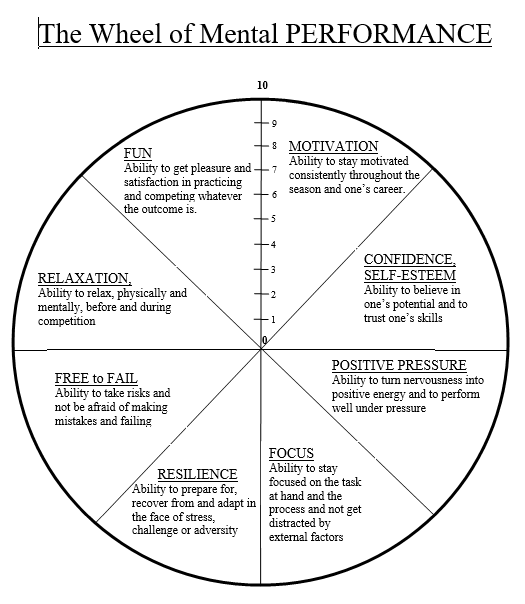
The Wheel of Mental Performance

pexels-photo-171198.jpeg


Do you want to know where to start to improve your performance?

Here is a tool that I created as a way for the athletes to assess themselves and visualize some key mental skills. It’s called the wheel of mental performance.

Wheel of mental Performance seule avec titre

Take the time to assess yourself, or to have your athletes assess themselves, with honesty by ranking your level in each skill between 0 (center of the wheel) and 10 (Current perimeter of the circle) and draw a line corresponding at that level in the associated area. The new contour will give you a visual representation of your Mental Performance.

Review results and make note of any insights that are revealed.

What did you learn?

What could happen if you were to improve some of these skills ?

Take Care,

Evan

How Much of Performance is Mental and what can you do about it?

When you ask athletes: “How Much of Performance do you think is mental?”, most often they answer between 50% and 90%.

I personally prefer seeing it the following way: to be at our best, ie 100% performant, we need to be at 100% on the physical side and at 100% on the mental side.

Generally, there is an agreement that the mental side has some significant impact on performance.

Now, when you ask them “How much of your time do you spend practicing the mental side?”, the answer is often “not a lot”.

So where does that gap come from? Here are several possibilities:

  • Some might think the mental side is something you have or you don’t have (confidence, focus, motivation, etc…)
  • Some might think they are already doing mental training just because they read or hear things like: “Common, you can do it, be strong!”, “you have to focus”, “just trust yourself”, “relax.”, “don’t be so nervous”.
  • Some might think this is just for top level athletes
  • Some might not really know what it is and how to practice

Here is what we can say about mental training

  • Our thoughts and emotions are impacting our performance, whether we are aware of it or not. The first step in mental training is to become aware of what we think, how we feel, and recognize how this might affect our performance. Yet this is not easy, in a world where we are supposed to be tough, not show our emotions, concerned about what other think etc…

  • Mental training is like taking our brain to the gym, it does for the brain what stretching and strengthening do for the body. When you practice mental training, you actually stretch the way you are looking at your performance and the possibilities offered by any situation, positive or negative; you learn and strengthen the ability to turn nervousness into positive energy, to focus, to relax, to bounce back after setbacks, to feel confident, to play well under pressure (and to like it!), so that you perform at your full potential… These are skills that can be learned.

  • A growing body of research shows the benefits of different techniques like mental imagery or other technique directly impacting our emotions, heart rate and overall physiology. This is a global mind/body/spirit approach that also translate into everyday life.

  • Now, as everything in life, it requires commitment and practice. As Thich Nhat Hanh puts it about meditation, “it is not a matter of faith, it is a matter of practice”. Knowing or believing is not enough, you have to learn and then practice on a regular basis.

  • Mental training is for anyone. Any athlete, whatever the sport, whatever the level, is human and therefore has thoughts and emotions that are compromising their full potential.

In the coming months, I’ll try to give valuable tips and illustration of the value of mental training.

Take care,

Evan