Commitment vs Attachment / Resignation

commitment

Photo by Nick Youngson CC BY-SA 3.0 ImageCreator

Attachment

Often when we set a goal for ourselves (get a certain number of clients or a certain income, achieve a certain performance, take a project to completion on time and on budget), we become very attached to achieving it. Some people don’t even set goals out of fear of not achieving them which is an extreme version of attachment (you are so attached that you don’t even want to take the risk to not achieve it). We then start to take action toward achieving this goal, we are excited, motivated, inspired. Then, at some point, we start to doubt that we will achieve it. Progress is not as good as we had expected, obstacles show up on our way, we start to run out of time, etc…

Resignation

That’s when we start to fall onto the other extreme, Resignation. We start to be resigned to not achieving our goal, which translates into less energy, less motivation, feeling bad, feeling like a looser and we give up.

Then we will set a new goal, with some doubts about our ability to achieve it already from the start, we will get inspired, motivated again to take action, and then fall back into resignation as soon as we will see signs that our goal might be out of reach in the timeframe we set. And we’ll start again, with a new goal and even less confidence in our ability to achieve it.

Globally, most of us oscillate on this Attachment / Resignation line and that is, at least for me, not very pleasant nor empowering.

Commitment

Rather than oscillate on the Attachment/Resignation line, I would like to invite you to come from a different place. It might be tempting to aim at the middle of the line, not too attached, not completely resigned. But what I am talking about is not even on that line, but rather outside of this line: Commitment.

What are you committed to in life?  The thing is, most of the time, our goals, at least our outcome goals, depend on external circumstances and although we would like to control everything, we can’t. Your commitment depends on you and only you.

I see commitment as threefold:

Commitment to your bigger goal/vision/purpose: a six figures business, going to the Olympics, creating/growing a nonprofit, making the organization you run the best place to work, creating an extraordinary life whatever that means to you, etc…

Commitment to your daily “blue collar” work: do the things you have to do on daily basis, even the unpleasant ones, no matter how you feel: give X number of calls, write, do your personal routine, train hard, serve people, etc…. Setting up a routine might be hard at first, just like when you start to pedal on a bike and start moving, the resistance is high. But then, as you keep going, you gain speed and momentum, and it becomes easier and easier. It is during that first part of setting a routine, when it is hard, that commitment can really help. Commit and don’t let any other option open. That’s how I started to meditate 4.5 years ago now and never stopped since.

Commitment to your thing in the moment: Set a strong intention to be 100% present to what you are doing and to give your best: with a potential client, instead of being attached to get that person as a client (or resigned when she doesn’t seem to want to become a client), stay committed to serving her the best you can. When you coach, lead or manage, rather than being attached to “perform” or have an answer for everything, be 100% present to what’s going on, connected to the other person. In a race, before the gun goes off, instead of being attached to winning/qualifying/doing a PR, simply commit to give it all, to push through when it is going to hurt, because if you are not clear on this, as soon as the pain will arrive or things don’t go as expected, you’ll be tempted to fall into resignation, which limits your ability to perform.

It doesn’t mean you shouldn’t set goals and aim at them, just that you might get benefit from identifying what the bigger purpose behind this goal is, what the actions you want to take on a regular basis are and what it means to be 100% focused on your thing, and then committing to those and coming back to that commitment when you catch yourself falling into resignation. This will help you move forward and be in a much better place in the end than just being attached/resigned. This might also show you that those things are more important than your goal itself, that if you stick to your commitment, you will grow and become a different, better person no matter what happens. In the end, it might well improve you whole experience of goal setting and goal getting.

Take care,
Over Confidence vs Ultra Confidence

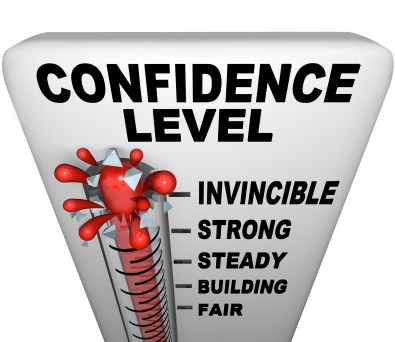
Thermometer - Confidence Level

Photo by VIC on Flickr

Do you have the right type of confidence? This applies to sport (primary focus of this post) but to any other area in life.

Confidence is a key factor in sport and when competing (and in life in general). One of the most common mental roadblocks I see in athletes (and in business) is a lack of confidence. I personally lacked confidence when I was a teenage swimmer. I was doubting that I belonged, I had negative thoughts about how I would swim poorly once again, and so on. And it really got in my way to perform at my full potential on a regular basis.

Developing a realistic healthy self-image is key in your ability to perform at your best. The good news is confidence is a learned skill that you can improve with regular work. Confidence and Self-esteem give you the ability to create and sustain an optimal performance regardless of the external conditions.
Some say that confidence comes first, other that confidence is a result. I believe it’s both.

  • You can build your confidence with some techniques I often speak about like positive affirmations or mental imagery (which send to your brain the message that you are confident and good no matter what happens or has happened), journaling your victories, remembering where you come from, etc… This builds a part of your confidence
  • Then, as soon as you achieve one important thing that you consider a success, your confidence skyrockets because that’s the proof your brain has been looking for.

Then you will forget about it, focused on the next goal, next obstacles. That’s when you want to bring back your past achievements as proof that you have been successful and that there is no reason why you couldn’t be successful again and use mental techniques again.

Now, there is a distinction I want to draw your attention on today, which is Over confidence vs Ultra confidence.

Over confidence is believing that you WILL succeed (win, score, etc…) NO MATTER WHAT you do and may be followed by disengagement and lack of focus. Over confidence looks like arrogance. Over confidence has you attached to a successful outcome and makes you forget about the important tasks. That happens a lot when you face a weaker opponent, whether in an individual sport or a team sport.

Ultra confidence on the other hand is a strong belief that you CAN succeed (even when it doesn’t look obvious) IF you give it all and perform to your full potential, and is followed by intention and strong focus. Ultra confidence is independent of external circumstances, even independent from the outcome (you are willing to accept to be defeated, or fail).

Tennis player Stan Wawrinka is a great example of Ultra confidence.  He is one of the rare players who tend to be better against the best players in the world during the most important matches (in grand Slam) than against weaker player in less important tournaments. And he defeated Djokovic in the last US Open. “In my generation, a lot of players, when they play Novak (Djokovic), Roger (Federer) or Rafa (Nadal), already have 10% less chances to win”, did he say. “I have seen a lot of matches like that. Mentally, I arrived to a point where, there are days I know that, when going onto the court, I won’t let the match go. I’m not saying that in an arrogant way, like “I’m going to win”, but mentally, I know I will be stable and that I will produce a very good tennis. Then, you may still lose, but because the other has been better.”
That’s exactly what I am talking about: knowing you can do it, based on YOUR ability, not in an arrogant way, just present to your full potential, and be OK with losing.

Develop your confidence, aim for an Ultra confidence that external circumstances won’t be able to shake, and pay attention to not fall into Over confidence.

2 takeaways from the Tour de France 2019

I rarely write or speak about cycling, but I think it’s really worth some words. This sport, at least the road biking, with the main big tours like the Tour de France, the Giro (Italy Tour) and the Vuelta (Spain tour)  combine a lot of various aspects of sport: it is both an individual AND a team sport, with more strategy than we might think, it requires a huge amount of ungrateful endurance training and it is one of the most painful sports I know, putting in some intense effort for hours, feeling the muscle pain in the legs, and the intensity pain in the stomach and heart. And in addition, it is a very dangerous sport with lots of falls, broken bones, torn skin and once in a while some deadly accidents. You need to be really motivated and committed to give it all despite the pain and to stay really focused when going down hills after intense efforts.

After this year Tour de France, in July, I wanted to share 2 things I have been present to:

Team Dedication over individual recognition:

This sport is a great illustration of what it means to give it all for a teammate. Even more than in a team sport like soccer, lacrosse or basketball, where the whole team gets the same result/score in the end, road cycling sometimes requires a cycler to give it all for his team leader who will get the main result in the end (victory, podium, points, etc…). A cycler will for instance lead the peloton at a high pace in the mountain to distance other teams, while the leader will stay “protected” behind the teammate (the one leading a group is putting in much more effort as he is in first place, mainly due to aerodynamics factors and the impact of the wind). It’s often that you will see a teammate literally give all he has until the tank is empty and he just can’t anymore and then leave the leading position to either another teammate, either the team leader, dropping at the back of the race to recover and end the race as he can. For him, no victory, no points, for recognition from the general public. His only goal is to pull as much as he can to put his leader in the best conditions, sacrificing all personal goals to his leader. Same things with sprint arrivals. Teammates will lead the group to a really high pace so as to “launch” their sprinter in the last hundreds of meters and then let him go for the sprint and the victory or podium. Whereas in a team sport the whole team will be recognized for winning, the teammates in cycling get far less recognition and the leader gets most of the light. I have a lot of respect for the dedication these teammates have and I think this could be used in any team as a great example of giving all for the team, beyond one’s personal goals, not letting the ego get in the way of the team’s objectives.

Resilience:

French win pretender Thibault Pinot showed and will have to show a great deal of resilience:

  • After losing 1min40s (which is a very important loss) when he got trapped in a second part of the peloton that couldn’t keep up with the leading part (because of the impact of the wind) in the first of the three weeks, he bounced back and attacked in several stages in the mountain and came back very close to his opponents, showing clear signs of strength and of a possibility for him to win the Tour. He was able to turn his big frustration of his 1min40s loss into positive energy, into the fuel that enabled him to retake this time in the mountain. And it is not sure at all that shouldn’t he have lost this 1min40s, he would have attacked this much and demonstrated such strength. This is what Resilience looks like. And you too can bounce back every time you get a bad start or have a bad result.
  • Then, 2 days before the end of the race (out of 3 weeks of racing), he had to give up because of an injury in his leg’s muscle, which he seems to have got by hurting his handlebar when trying to avoid people falling in front of him in a downhill. I found this heartbreaking, because he is French of course and no French has won for 34 years 😊. But even more because it feels so unfair. Last year he had lost the podium on the last day of the Giro (Italy Tour) because he fell really sick (sort of pneumonia). And this year, as he seemed to be in his best shape ever, this injury popped up 2 days before the end… He is still devastated and can’t accept it. Such strokes of bad lucks are unfortunately part of sport. You have to deal with it. It is painful, it takes time. And your ability to bounce back will determine what sort of athlete you are. Once you gave room for the frustration, the disappointment even the distress to express (better to let these feelings be rather than cover them up and pretend they are not there), you can bounce back and use this as an extra motivator to fuel you with even more determination and commitment. As Pinot said lately: “Only winning the Tour de France will help me forget, a podium won’t be enough”.

Take care,

5 tips to go into Tryouts

sport silhouettes

Tryouts are often a stressful moment for athletes and I wanted to share 5 (+1 extra) tips on how to go into the tryouts to help you or your kids increase your/their chance to succeed and have a better experience. 

  • Detach yourself as a person from the results of the tryouts

No matter if you make the team or not, you are still a good person, with more than your sport in your life. If you can see that clearly, this will relieve the pressure. It doesn’t mean to not want to succeed and it doesn’t mean you shouldn’t give your best, it means that you are not defined by your results. You are more than that. And this helps move on when the results are not as expected. 

  • Focus on the Process, Not the outcome

Worrying about whether you are going to make it or not and have “what if” thoughts (what will I say if I don’t make it, what will my parents/friends/coach think if I make a mistake, etc…) will only take some mental space and energy for nothing. Instead, focus on the task at hand. Remember that Where your Attention Goes, the Energy Follows. The Future doesn’t exist, the only moment you can have an impact is the present, Right Here, Right Now.

  • Focus on yourself, not others

Tryouts are a little special in the sense that the main objective is to compare athletes to select some of them. So, it is even more tempting to compare oneself to others… But you can’t control others and the way they play. You can only control yourself. Wondering if this person is better, looks better, will be better etc… doesn’t help at all. Like focusing on the outcome, it only distracts you from being focused on what is important: your game, right here, right now.

  • Trust your skills

Now is not the time to wonder how to improve your move, your shot, your swing, your pass. Trust that you are well prepared, that you know how to do it and avoid overthinking.

  • Have a good attitude

The attitude is very important and sometime even more important than the skills. A player that will bring a hard-working attitude, positive mindset and team spirit (for team sports) have an advantage compared to an equally skilled/talented athlete.

Now that we have seen the 5 tips, here is the extra one: 

  • Have Fun

The reason you practice a sport in the first place is to have fun. Reminding yourself to have fun will help with all the above: it will relieve the pressure, have you focus on the process rather than the outcome, focus on yourself and not on others, trust your skills and have a good attitude.

Eventually, all the techniques I regularly share to deal with nervousness, refocus, like taking deep breaths or using visualization, will be very helpful too, just as in any competition.

If you need some support going into the tryouts, reach out and let’s work on it.

It would be absurd to be afraid of things we’ve dreamed of

photo-by-filip-mroz-on-unsplash.jpg
Rolland Garros is approaching its conclusion and it’s pretty exciting if you love tennis. The big 3 (Federer, Nadal, Djokovic) is back in a Grand Slam semi-final all at the same time, joined by one of the best man on clay, Dominic Thiem.

But I what I want to talk about today is a message that was insightful for me as I read an interview from a young French tennis player, Antoine Hoang, who is completely new to the main professional circuit, having played challenger tournaments only for a year and participated to his first Grand Slam tournament at Rolland Garros, having benefited from an invitation. He won his first 2 matches, the second against Verdasco, one top player on clay, in front of thousands of people which was not usual for him and could have added a lot of pressure. But he didn’t let that interfere with his game. “I am happy that I haven’t been overwhelmed by the event”, he said. I thought that it was what I had been dreaming of for a long time. So, I told myself “don’t start to freak out, it would be absurd to be afraid of things we’ve dreamed of. You are where you wanted to be, so there is no reason to be afraid”.

Although it’s not really absurd to be afraid (it’s a normal physiological reaction ingrained in our primitive brain which helped the human beings to survive through millions  of years), I really love this reframe, this shift in perspective and I believe this can be useful for any athlete undergoing fear in an important competition. It’s OK to be scared or nervous. What you don’t want is to be paralyzed by fear and instead keep trusting yourself and switching that nervousness into positive excitement. Remembering that at some point, you dreamed to be in this situation helps do this and go beyond the fear of this new situation. If you are afraid to not be good enough in a new team (high school, college, next level league), remember you dreamed of it, if you are scared to fail at an important competition (state Meet, Nationals, Junior Olympics etc…), remember than you dreamed to be there. And If you are there, you belong. Trust yourself. It would be “absurd” to be afraid of things you’ve dreamed of.

By the way, this applies to any other area in life: a professional promotion, a next level in business, a new relationship, etc…
Take care,

2 tips to deal with stress from a Rollerskater World Champion

Record_du_monde_de_saut_-_Taïg_Khris_-_Paris_2010_-_024

Taïg Khris is a rollerskater,  X games winner and triple world champion and an entrepreneur. I listened to an interview last week where he shared how he used to deal with pressure and stress during his roller competitions (and also when speaking in front of thousands of people). Here are 2 things he said:

  • When his mind kept getting out of focus, with a lot of negative thoughts and doubts (what if I miss my figure?, what if I fall?, will I succeed?, will I get injured? etc..), he then repeated to himself only what he had to do (which figures, etc…) and positive words (It’s going to be OK, I will perform etc…), without stopping, constantly. This prevented his negative thoughts to come in by keeping his mind busy with the task at hand (the process) and the positive things. He is using the same technique when speaking in front of 1000 of people (repeating what he has to say and incorporating positive words). This is a great illustration of what I often speak about: focusing on the process (rather than the outcome), focusing on the positive and on what you want to see happening rather than what you fear can happen, and using power words to reinforce this message. And it works. You can do this whatever your sport is.
  • When the fear was very intense like when he jumped from the 2nd floor of Eiffel Tour and landed on a roller ramp (40m high) in front of 5000 people, his legs were shaking (Note: even the best champions get scared, so you can get scared), he played down by asking himself what was the worst that could happen. He thought he might break his arms or legs (he didn’t really think he could die) and that would be it (not a big deal for him since he broke his arms, legs, ribs, shoulders several times for some of them…). And it helped him relax and go for it. Now, I’m not suggesting to do anything risky by telling yourself you might just get a broken arm or leg, but that everyone can find a way to play down what’s at stake. And usually, in many sports with no big risk like jumping from the Eiffel Tower, the main fear is to fail, make a mistake, lose, etc… And it’s simple (not always easy) to realize that in a bigger picture (the whole season, the whole college years, the whole career, and eventually the whole life), it’s not such a big deal.

So, how can you apply this in your next game, race, school exam or public speaking?

Take care,

Why Mindset is key when going into a soccer game (and in any sport)

Photo by Jannes Glas on Unsplash

Photo by Jannes Glas on Unsplash

Over the past 2 weeks was the round of sixteen of the Champions League (European main soccer competition), where the best out of 2 legs advance to quarter finals (when there is a tie after the 2 legs, the one who has scored more goals away (at the other’s venue) wins).  Here is what I noticed when it comes to the mental approach or the Mindset:

  • On one hand Paris Saint-Germain (PSG) doesn’t seem to get it when it comes to mental approach. Since Quatar invested massively in this club in 2011, they tried to build a top level club, bringing 5 stars players like Zlatan Ibrahimovic, David Beckham and more recently, Neymar Jr and Kylian Mbappe. And yet, it doesn’t seem to make any progress in this champions league, never able to go past thee quarter final and eliminated in the round of sixteen in the last 2 editions. 2 main events are symbolic of this lack of mental toughness:
    • In the so called “Remontada” in 2017, PSG had won 4-0 against Barcelona in the first leg, and was leading 3-1 after 88min in the 2nd leg despite a feverish way to play. There was no way they could be eliminated since Barcelona needed to win 6-1 to qualify with the “goals away count more” rule. And yet, Barcelona scored three times in the last 7 minutes to get the qualification out of PSG. PSG had gone into the game with fear, backing off instead of playing their game. When fear leads your way to play and you focus more on what you don’t want to happen, it’s actually more likely that it will happen. All had failed, from the coach to the captain and the seasoned players.
    • This year, PSG had won 2-0 against Manchester United in the first leg in England, which was a great result considering they were missing 2 of their strikers (Neymar and Cavani). PSG had shown some character in the first round of the competition, being present, focused and competitive in risky situations, which seemed to indicate they had improved on their mental approach. When Manchester came to Paris for the 2nd leg with 10 main players missing due to injuries or suspensions (so with a C team so to speak), PSG had all the cards in their hand to qualify for the quarter final. And once again, they didn’t put the right intention, the physical impact and the required focus that is mandatory at this level. And at 93min, in the overtime, Manchester obtained a penalty and ended winning 3-1, eliminating PSG. When you can’t rub it in, you are putting yourself at risk.

  • On the other hand, Ronaldo proved why he was the best player in this competition. Transferred from Real Madrid to Juventus Turin last summer, Ronaldo was criticized for his lack of impact in the beginning of the competition. It got even worse when Juventus was beaten 2-0 by Atletico Madrid in the first leg. But Ronaldo is Ronaldo, like Lebron James in the past years. He was super confident that they were going to win and qualify in the 2nd leg at home. He shared that with other players a week before the 2nd leg and in the media a few days before the game. And he amazingly scored three times in the 2nd leg and qualified Juventus almost on his own. The whole team had a great game of course but he was decisive. Not only does he seem to be pressure proof (I’ll talk more about this in a next post), he seems to find ever more motivation and determination when the stakes are higher.


There is a key difference between how PSG and Ronaldo approached their games. On one hand, there was a lack of clear intention, lack of focus, lack of the needed fire to get things done, lack of commitment. This might have been due to some fear because of what had happened in the past. And this might have been due to over confidence, as PSG has often been accused of in the past years, which is the belief that you will win without needing to give it all (with some sort of arrogance). On the other hand, there was (ultra) confidence that it is possible AND that you will give it all to make it happen. It’s followed by commitment, intention and focus.

Of course, it’s not all about this, of course not everyone has Ronaldo’s talent, but the more you can put yourself into a confident AND committed, intentional, focused mindset before a game, the better your play will be, the more likely things are to turn to your advantage. And this is true to any sport.

Take care,

Only 10%

Photo by HENCE THE BOOM on Unsplash

Photo by HENCE THE BOOM on Unsplash

This week, I want to illustrate that sometimes, although we might we feel like there is a world between us and what we want to achieve, the gap is not that big.

US tennis player Danielle Collins was the revelation of the women Australian Open Grand Slam tournament, reaching the semi-final for the first time in her career. In quarter final, she managed to beat Anastasia Pavlyuchenkova, 2-6, 7-5, 6-1 after losing the 1st set 6-2. In this 1st set, Pavlyuchenkova broke her 3 first serves and Collins was down 5-1. But she didn’t give up nor panic:

Honestly, I lost that set pretty quickly,” Collins said. “But what was going through my mind was that I think I had at least two break points that I didn’t convert. Even though the set was 6-2, it took an hour. I felt like it was very close, regardless of the score. I told myself, ‘Hey, if I can just give a little bit more, 10 percent or 15 percent, I have an opportunity.’ Yeah, I stayed positive through that and kind of weathered the storm.”

I really love the way she didn’t let the score of the 1st set (6-2) mean anything (it could sound like she was hugely dominated) but instead relied on her sensations and analysis.

Lots of us see things as all or nothing, black or white. When it’s not white, it means it’s black, when it’s not all, it’s nothing. No surprise that the gap often feels very big, close to 100% and therefore impossible or at least really difficult to bridge. But if we can see that the gap may be much smaller and ask ourselves what tiny change can I make, where can I give 10% more (energy, focus, calm, determination, precision, …whatever it is that we need), then it’s easier to make the necessary changes, we have more confidence in being able to do it and in the end we can make what feels impossible possible.

If you are racing (running, swimming, cycling) and are used to mentally or physically giving up at a certain point, can you go just 10% further instead of trying to hold the whole race right away?

If you are a golfer, can you manage your emotions 10% better instead of trying to manage them 100% and be even more frustrated if you don’t do it?

Lots of team sport games are very indecisive and focusing on giving 10% more rather than thinking you don’t seem to be able to and won’t find the solution can make the difference.

So, where can you give only 10% more to make a difference?

Take care,


Djokovic, from burn-out and surgery to playing in the zone

If you want to know what it means to be in the zone, watch Novak Djokovic’s semifinal and final at the recent Australian Open. During this Grand Slam, he progressively increased his level to sharply beat French player Lucas Pouille in semifinal but more surprisingly to give no chance to Nadal in final, who had yet played an amazing tennis until the semifinals and was expected to challenge Djokovic.

After winning the semifinal, Djokovic shared that he was in the zone: “Every professional athlete hopes to reach it”. He describes it as “one of those moments when, almost effortlessly, you execute automatically anything you intend to do. You don’t even need to think anymore. You are guided by a force that is beyond you. You feel divine, like you are in another dimension.  This is an extraordinary feeling we all hope to experience.”

After 18 months of struggle both physically (with an elbow injury ended with surgery) and mentally (first with something that looked like a burn out after winning the 4 Grand Slams in a row and then to rebuild his confidence), Djokovic has become again a winning machine, taking the last 3 Grand Slams. To come back to such a high level, Djokovic has shown, just like Federer and Nadal before him, humility and patience, has worked hard on his technical skills and physical preparation but also on his mental preparation as he shared after winning the tournament. To the question “what would you have answered if you had been told a year ago that you would win the next 3 Grand Slams?”, Djokovic replied:

“That it was not impossible but highly unlikely. I don’t want to look arrogant but I have always believed in myself. This is probably the most important secret of my success. I believe a lot in visualization. I use it a lot. I have used it more than ever in the last 12 months after my surgery, because I was not playing well, I didn’t feel good on the court, I was questioning everything, I was doubting my ability to play at my best level again because I didn’t know how much my surgery would impact my game. This has been an instructive turn for me. I wouldn’t change anything if I could go back.”

We can see that his impressive mental toughness comes from a strong self-confidence, even with lots of doubts along the way, and practicing mental training techniques like visualization. Also named mental imagery, this technique enables the athlete to use the same neural pathways and is great to use when recovering from an injury, when you can’t yet train normally or right after coming back, when you need to work on your moves. It’s also very useful to (re)build your confidence. And it helps to get in the zone, as other mental and emotional skills.

If you want to get a chance to reach the zone, improve your mental and emotional skills. And if you want to know how to improve your mental and emotional skills, you know who to contact.

Take care,

3 parallels between the Aerospace Industry and Sport

Rocket

I’d like to start this Sport Mental Game Coaching year by sharing 3 parallels I made between my experience in the aerospace industry and sport.

  1. Be prepared and ready and focus on what you can control to boost your confidence

As a swimmer, I used to lack confidence in competition. And as I started my career as engineer and quickly project manager in the space industry and for the French and European Space agencies, I had that same lack of confidence at first. I built it with experience of course. But I noticed one thing. The more prepared and the readier I was, the more confident I was. When I had to present and defend a certain position, if I had reviewed all my technical points, prepared my argument, prepared for the questions that might be asked, I was feeling confident. If I was not completely clear, if I had doubts, if I had failed to analyze something, I was not confident. And the more I focused on what I could control (my analyses, my actions, my presentations, etc…) rather than worry on things I couldn’t control (what if something new shows up, what if someone doesn’t understand what I explain, etc…), the more confident I was.

This is the same in sport: if you are prepared (you know you trained well physically, technically, strategically and mentally, you rested well, you ate well), if you feel ready to just do what you have learned, if you don’t let room for doubts, AND don’t focus on what you cannot control (the other opponent, the weather, the referee, what people will think, even just the outcome), then you will be more confident.

  1. Differentiate yourself from your sport and performance

When you work on Rocket launches, you can feel like the whole launch’s success is in your hands…Even if you work on small part of the program, even if you are not the only one to check and validate. It feels like one error can lead to a failure. And it can be overwhelming. It feels like your whole life depends on what’s going to happen. So, I learned to differentiate myself as a person from my job and work. I learned to remind myself that I was just a guy doing his best, doing his part of the job, and that no matter what would happen, I would still be a good person, with another part of my life still there, with family and friends to care for and to be cared from.

When we are passionate and competitive, our sport can take all our mental space. And as soon as we lose, we feel like our whole person is a loser, failed, disappointed others. And it can be devastating, specifically at a young age. So, my invitation for you is to remind yourself as often as possible that, no matter what happens, your sport performance doesn’t define you. You are more than that and if you feel not good enough, that you are less than others, just know that this is not true. There are parts of you, strength, qualities that others don’t have, that may not be seen in your sport and performance and that make you an awesome person overall. It doesn’t mean you shouldn’t want to improve and develop certain qualities and be ambitious, just that you should see the whole picture.

  1. Have Fun

I remember difficult times when we had to work late and hard to clear a launch. It can be draining on the long run. Bringing some fun helped recharge, stay motivated and focused and move on. Even in the tough times, you want to allow some moments of fun, to take the pressure of.

This is the same in sport. If you forget to have fun, you won’t last. If you forget to have fun, you won’t even play at your full potential. If you forget to have fun, what’s the point in training so hard?

Take care,